Science and religion must unite in the fight against suffering
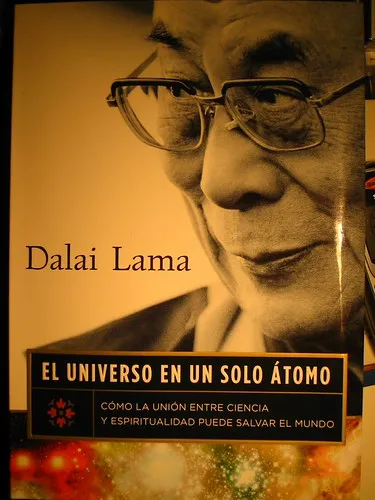
The Dalai Lama's latest book, The Universe in a Single Atom, constitutes an original form of memoirs in which, through the thread of his personal encounters with an endless series of top scientists, he reflects on the image of the universe, of life, and of man in science from the point of view of Buddhist religion. The Dalai Lama thus offers us his evaluative point of view on the great advances of science, shows the frequent coincidences with Buddhist doctrine and also the points of disagreement. Science and Buddhism can illuminate each other to reorient an increasingly deeper knowledge of reality. In quantum mechanics and cosmology, science and Buddhism present more evident coincidences. In the explanation of life and, above all, in the explanation of human consciousness (of the "soul"), their differences with science become, however, inevitable and decisive. By Guillermo Armengol.
Via Tendencias21
In the recent book The Universe in a single Atom (Ramdon House, N.Y. 2006, Spanish translation by Grijalbo), the Dalai Lama dazzles us again with his humble, simple, open temperament, at the same time intelligent and profound.
It is admirable that a person with essentially Buddhist training has been able to achieve a precise and very well-formulated knowledge (although not technical or professional, but that of a simply curious and intellectually restless person, as he himself confesses) of the most complex topics of modern science.
His restlessness covers an enormous variety of fields: from the physics of matter, through cosmology, to modern biology, genetics, neurology and psychology. Great scientists, as he himself relates in a personalized way, contributed with their personal teachings to this suggestive scientific and cultural formation of the Dalai Lama: David Bohm, Niels Bohr, Popper, Richard Davidson, Paul Davis, Paul Ekman, Daniel Goleman, Eric Lander, Robert Livingston, Francisco Varela or Carl F. von Weizsäcker, among others.
Buddhism, a philosophy without a "Book"
The Dalai Lama initially insists that Buddhism is a philosophy without a "Book". Just as Christianity or Islam are religions of the Book (the Bible or the Quran), Buddhism does not have canonical scriptures that must be considered "revealed," or an absolute point of reference that allows unequivocal access to the truth of that religion.
In reality, Buddhism is an ancestral philosophy that has been constituting a body of doctrine that is accepted, but on almost all its points it presents numerous variants. It is a form of spirituality that constitutes a powerful tradition and remains faithful to some great principles, tested over centuries.
He insists that this philosophy has aimed to know the truth and guide man towards overcoming suffering and towards happiness through the use of reason. Thus, Buddhism is subject to reason in the sense that, just as reason was exercised in its ancestral tradition, so too today it can continue to be exercised to indicate an improvement in overcoming suffering and in perfecting its spirituality.
That is why the Dalai Lama is an enthusiastic knower and admirer of modern science. Science is also (like Buddhism) an exercise of reason and can contribute much to Buddhist beliefs. Throughout his exposition, he refers in several places to his interest in having introduced knowledge of science into the academic curriculum of Tibetan monks.
Limits of the philosophical flexibility of Buddhism
The Dalai Lama insists that even those texts attributed to the Buddha are not an absolutely normative reference. It is true, however, that both the texts of Buddha and those of other important Buddhist philosophers, and even texts from the Indian philosophical tradition, constitute a heritage of thought in which Buddhist spirituality is firmly rooted. The wealth of texts and authors, in various philosophical traditions and in various countries, is very great. Sometimes the same problem gives rise to different opinions, in reality not reconcilable with each other.
From among this enormous quantity of philosophical possibilities, the tradition of Tibetan Buddhism has its preferred texts and authors. Thus, in general, Tibetan Buddhism is situated in the tradition of Mahayana Buddhism.
The Dalai Lama knows how to choose those texts and authors that in each case are more apt to enter into convergence with the results of science. Therefore, his considerations must refer to Tibetan Buddhism, setting aside the analysis (also possible) of the relationship of science with other Buddhist traditions such as Tantric Buddhism (very present in Tibet) or Chinese or Japanese Zen Buddhism.
In this process of Buddhism-science conciliation, the Dalai Lama has a much easier path when dealing with topics of physics, be it cosmology or microphysics (quantum mechanics) than when dealing with topics of biology (evolution) or anthropology.
Specifically, a crucial point is the ancestral doctrine of Buddhism on reincarnation. In this, modern science (the neurological idea of man, emergentism or the theory of mind) offers no basis whatsoever for thinking that something like reincarnation is possible, scientifically plausible.
And here the limit of Buddhist openness to innovation that reason can offer in our time from science clearly appears. At this point, the Dalai Lama seems, in effect, to recognize that science does not support reincarnation. However, he considers that it also does not prove that it cannot be true and, therefore, he continues to maintain it in the Buddhist tradition.
This means that there are limits where, if certain things are not accepted (for example, reincarnation), the backbone of Buddhist doctrine and spirituality crumbles. In these cases, the flexible openness of Buddhism to dialogue with reason is not maintained, as it yields to the weight of its ancestral tradition.
Quantum mechanics
Classical Buddhist doctrine observes that everything is impermanent and transitory. Everything comes undone and passes, this being the fundamental cause of suffering. Hinduism and the ordinary view of man grant real things or worldly circumstances stability and ontological consistency. But, in truth, it is a profound error that causes suffering.
But Buddhism changes the point of view and establishes the universal law of "dependent origination" which tells us that every phenomenal state is inconsistent and is only a moment in a chain of interactions in dependence. This chain of causes and effects produces the illusion of a real phenomenal world that is pure transitory inconsistency.
The origin of suffering consists of karma which makes us become trapped by this false consistency of the phenomenal world. Liberation consists of fleeing the transitory world and avoiding falling into it through reincarnation.
Quantum mechanics, according to the explanation insisted upon by the Dalai Lama, has contributed to explaining microphysical matter (the true background of things) as an inconsistent flow very similar to that defended by the traditional doctrine of Mahayana Buddhism. Both atomic theory and particle theory were prefigured in Buddhist physics, with an idea of "emptiness" as the background and origin of things.
"The paradoxical nature of reality, as revealed by the Buddhist philosophy of emptiness and modern physics, represents a great challenge to the limits of human knowledge ... The philosophical problem faced by physics in light of quantum mechanics is whether the very notion of reality – defined in terms of essentially real constituents of matter – proves sustainable. What the Buddhist philosophy of emptiness can offer is a coherent model for understanding reality that is not essentialist" (p.88-89).
Cosmology
The Dalai Lama presents versions and contents of ancient cosmologies from the Buddhist tradition that are today incompatible with science. However, there are traditions that present significant coincidences. The universe is inconsistent, according to the law of dependent origination: it is a continuous illusory making and unmaking to which no original cause or foundation can be attributed.
"At the heart of Buddhist cosmology lies not only the idea of the existence of multiple cosmic systems – infinitely more than the grains of sand in the Ganges River, according to some texts – but also the notion that they are in a constant process of formation and destruction. This means the universe does not have an absolute beginning.
The questions this idea poses to science are fundamental. Was there a single big bang or were there many? Is there a single universe or are there many, an infinite number of them even? Is the universe finite or infinite as Buddhists assert? Will our universe keep expanding indefinitely or will it decelerate, even stop, until everything ends in a great implosion? Does our universe form part of a cosmos in an eternal state of reproduction?
Scientists debate intensely around these questions. From the Buddhist point of view, an additional question arises. Even admitting there was only one great cosmic explosion, we can ask, was that the origin of the entire universe or only the beginning of our particular cosmic system?
The fundamental question, therefore, is whether the big bang – which, according to modern cosmologists, marks the beginning of our current cosmic system – was the beginning of everything" (p.103).
Life, evolution, human soul, genetics
On these very important topics of modern science, it is already much more difficult to find illuminating coincidences from Buddhist philosophy. The Dalai Lama recognizes the lack of coincidence, but insists that the Buddhist points of view cannot be considered absolutely rejected by science either (since it has not reached the end and maintains unexplained enigmas).
He leaves open a final possibility for them to be the ultimate truth. The belief in reincarnation is above all difficult to harmonize with science. The Dalai Lama remains in his beliefs and, furthermore, shows himself to be radically critical of classical reductionism applied to biology and, above all, to modern genetic engineering.
The human sciences have been constructed, under the influence of reductionism, preferably by the behaviorist method of the "third person." But nowadays everyone tends to recognize the role that empirical experience in the "first person" must play.
This is where the Dalai Lama believes that the subjective and interior experience of Buddhist spirituality, with its long introspective tradition, could provide modern neurology with important empirical evidence that would open it towards a more enriched, more real, and more human science.
Buddhist atheism
Buddhism is an "atheistic" religion that must be understood precisely. The drama of human suffering, already from Buddha's experience, does not make it plausible to speak of God (and this connects with his criticism of popular Indian Hinduism). Hence, Buddhist cosmology also abounds in arguments against a theistic fundamental cause. The Dalai Lama, although with great respect for theistic religions, therefore defends the classical atheism of Buddhism.
However, in that "wheel of time" that turns the universes, souls are trapped by karma in the transitory and remain subjected to suffering through successive reincarnations. But, through Buddhist asceticism (the eightfold path) and, above all, meditation, one comes to overcome "desire," avoiding reincarnation and entering Nirvana.
What is Nirvana? For Buddhism, it is the final state entered after the cycle of reincarnations (samsara). It is transcendent and cannot be explained from this side. The minor gods or Devas of popular Buddhism are not in Nirvana; they are part of the phenomenal or transitory world. It is the state corresponding to the third body of Buddha (doctrine of the three bodies of Buddha): it is the reality of the transhistorical or glorified Buddha (in Buddhism we could say "nirvanated").
Nirvana is an enigma lived as a supreme hope. What does the enigma consist of? It cannot be answered and, therefore, ultimately, it cannot be excluded nor affirmed that it is God; if something could be said (for example that it is not God) the enigma would be unveiled. For this reason, Buddhist spirituality walks, let's say, "without God" towards a final hope of salvation that receives the enigmatic name of Nirvana.
Buddhism and Christianity
Christianity has been understood for centuries from a Greek ontology, now archaic in the light of science. That is true. But Christianity is not identified with Greek ontology and can enter into compatibility with the great principles of the image of the universe in science (see the article: The theology of science, a new proposal for understanding the world, in this same section). Let us just say that Christianity and Buddhism are united by the profound experience of the drama of human suffering and both have a spirituality open to a future of transhistorical salvation.
The essential difference is that Buddhism remains without words, does not dare to pronounce the word God from the experience of suffering and lives an atheistic, Godless, mysterious path towards salvation. Christianity, on the other hand, believes in the God who reveals himself in the tradition of Israel and in the mystery of Christ. On the cross it receives the message of a God who reaches kenosis, self-emptying or self-annihilation in a world where suffering has a meaning in the history of salvation.
In the resurrection it receives the message of a God who will bring about a final transhistorical salvation of humanity, eschatologically overcoming (at the end of time) human suffering. Christianity is the acceptance of a saving God through personal and free adherence to the mystery of Christ.
Buddhism, then, from the suffering drama of samsara, does not understand that suffering has a meaning in God. Christianity, supported by the mystery of Christ, believes (although it is experientially difficult for it to understand, just as it is for the Buddhist) that suffering has a meaning in the saving plan of a personal transcendent God. Accepting divine kenosis is to be religious in a Christian way.
Guillermo Armengol is a member of the CTR Chair. Article prepared as a commentary on the book by the Dalai Lama, The Universe in a Single Atom. How the Union of Science and Spirituality Can Save the World, Grijalbo, Barcelona 2006.
Saturday July 15, 2006
Guillermo Armengol