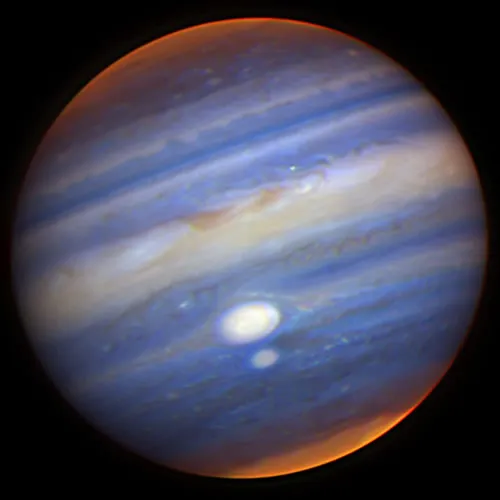
The Gemini North telescope, located in Hawaii, obtained an image in the near-infrared using adaptive optics that corrects, in real time, most of the distortions caused by turbulence in Earth's atmosphere. The result is an image from Earth that has nothing to envy from those taken from space.
Via Cielo Sur
"It was difficult to get this image," said Gemini astronomer Chad Trujillo "Because when we use adaptive optics we need a nearby object (like a star) as a guide. We had to wait for the moment when Io was quite close to Jupiter and the red spots optimally located. Luckily, this all happened during the afternoon of July 13 and we were able to capture this, the relatively rare set of circumstances," said Trujillo.
Both red spots are storm systems. The larger one, long known as the Great Red Spot, is approximately 8 kilometers above the nearest clouds and is the largest known hurricane in the Solar System. The smaller one (officially called Oval BA), but informally known as The Little Red Spot is another hurricane-like system. Since it appears almost as bright as the Great Red Spot in the near-infrared, both are probably at the same height in Jupiter's atmosphere.
The Little Red Spot is approximately half the size of the Great Red Spot. This new storm, formed between 1998 and 2000 from the merger of three long white ovals, had been observed for at least 60 years. But it was on February 27, 2006 that Filipino amateur astronomer Cristóbal Go discovered that the color of the newly formed white oval had turned brick red. Astronomers were witnessing the birth of a new red spot.
The image was produced by Travis Rector of the University of Alaska, Chad Trujillo of the Gemini Observatory and the Gemini ALTAIR adaptive optics team.
More information at:
http://www.gemini.edu/
The image in the note was taken from the Gemini Observatory website.