The observation of a quasar located 12,300 million light-years away allows the detection of molecular hydrogen in a remote galaxy whose light reaches us from an epoch when the Universe had reached 10% of its current age. Similar studies in two other quasars and high-precision laboratory measurements suggest that the masses of the proton and electron could have varied over time.
Via Astroguía
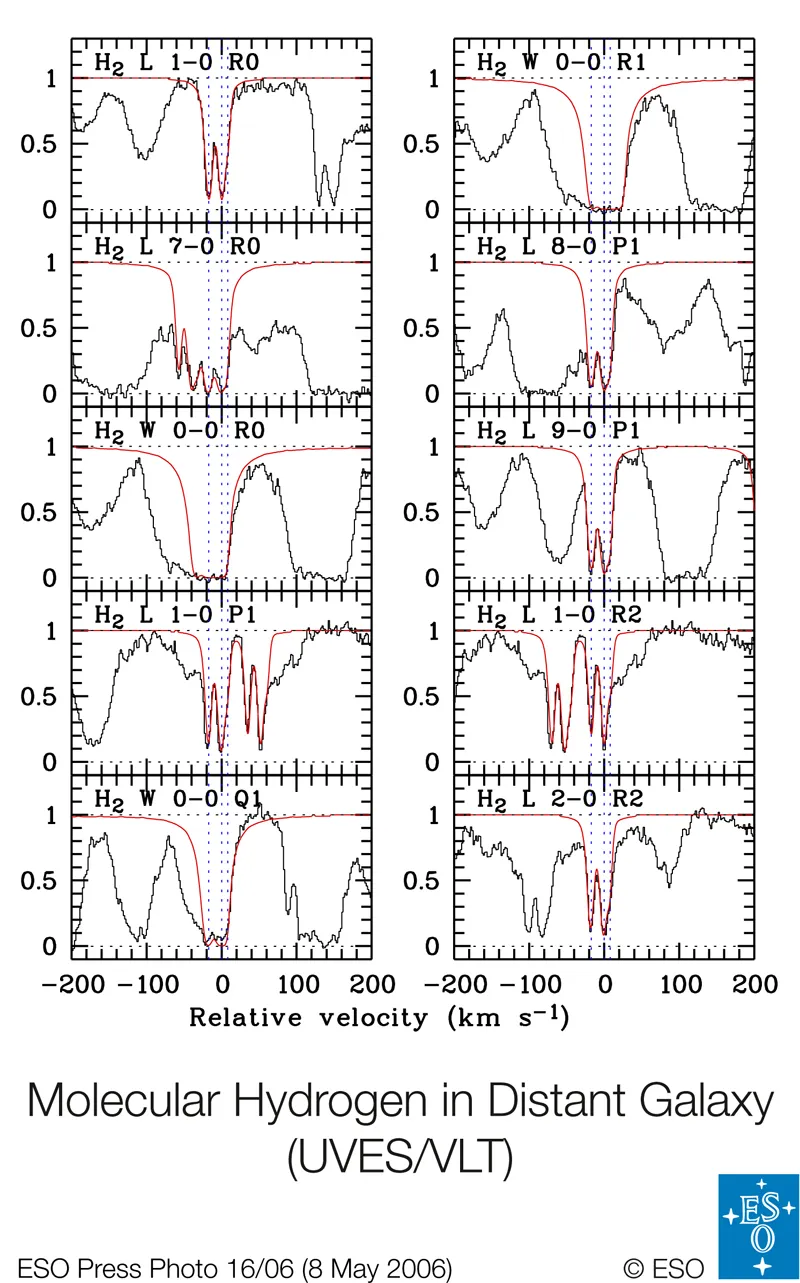
A quasar can be used as a beacon by astronomers because its light undergoes variations when passing through the interstellar gas clouds of some closer galaxy located along the same line of sight. This gas absorbs part of the light emitted by the quasar and thus the resulting spectrum presents dark "valleys" attributable to well-known and perfectly identifiable chemical elements.
An international team of astronomers detected in this way molecular hydrogen in an invisible galaxy that we observe when the age of the Universe was only 1,500 million years, 10% of its current age. The proportion was one molecule per 250 hydrogen atoms. A similar battery of observations for two other quasars, together with the most precise laboratory experiments, suggested to the scientists that the ratio between the respective masses of the proton and electron could have changed over the course of time, a finding that, if confirmed, would carry important consequences for our understanding of physics.
Image: molecular hydrogen in a distant galaxy. Spectrum of the quasar PSS J 1443+2724 revealing another invisible galaxy at z = 4.224. Superimposed on the observed spectrum, in black, appears in red the best fit. [Enlarge image]
Although molecular hydrogen is the most abundant molecule in the Universe, its direct detection is not easy because it is a symmetric molecule without intense spectral lines in radio waves. In certain regions of space it cannot survive because ultraviolet starlight easily dissociates it, but it constitutes the fundamental ingredient of dense and cold molecular clouds. In the distant Universe the only way to detect molecular hydrogen is through its mark on the spectrum of quasars or the remnant glow of gamma-ray bursts. But all this requires large telescopes and high spatial resolution to achieve the necessary precision.
Astronomers Cédric Ledoux (ESO), Patrick Petitjean (IAP, Paris) and Raghunathan Srianand (IUCAA, Pune, India) carried out a search for molecular hydrogen at very high redshift (z) using UVES (Ultraviolet and Visible Echelle Spectrograph) on the VLT at the European Southern Observatory. Among the observed systems, 14 bore the signature of molecular hydrogen, and among these one was at z=4.224 whose presence was revealed in the light of the quasar PSS J 1443+2724, distant 12,300 million light-years, from certain characteristics, including numerous molecular hydrogen lines that broke the record for detection of this molecule in the most remote objects of the Universe. This in turn implied that the gas in this galaxy must be at rather low temperatures, between -90 and -180°C.
Additionally, several lines corresponding to metals were also found, revealing the quantity of several chemical elements; for example, from the observed nitrogen abundance it was deduced that this element had to be produced in the final stages of the life of stars of 4 to 8 solar masses. Star formation therefore took place at least between 200 and 500 million years before the epoch in which we observe the galaxy, when 1,000 million years had passed since the birth of the Universe. This time span, of 200 to 500 million years, is necessary for a star with the aforementioned mass to synthesize and expel into the interstellar medium nitrogen in a quantity similar to that observed. If the galaxy went through a phase of intense star birth, now, at the time of observing it, it appears in a quiescent state.
The observation of the interstellar medium of a galaxy at very high redshift from the VLT, in particular using GRBs as beacons that illuminate it, will notably boost this field of research in the future. Using carbon instead of hydrogen, the same authors obtained the temperature of the cosmic microwave background radiation at that epoch. This fossil radiation was emitted as a direct consequence of the Big Bang, when the Universe reached 300,000 years of age and a temperature of 3000 K. As the expansion continued, it cooled and dropped to 3 K (-270°C) today. At 1,500 million years, the epoch in which we observe the aforementioned galaxy, the temperature of the Universe -as these observations showed- was 14 K (-259°C), which is in perfect agreement with the Big Bang theory.
The astronomers also measured the molecular hydrogen lines in the quasars Q 0405-443 and Q 0347-383 and the entire set of data offered the possibility to compare the ratio of the mass of a proton to that of an electron in today's molecular hydrogen with what it could have been 12,000 million years ago. For this, measurements of the spectral lines of hydrogen molecules in the laboratory are used to compare them with the same lines in the spectrum of the observed quasars. These measurements show that the ratio between the mass of the proton and the electron could have changed, becoming 0.002% smaller 12,000 million years ago. It is an apparently tiny change but with profound consequences for current physics. The scientists insist, however, that these results constitute an indication, but not proof, and must be confirmed with additional measurements, both astronomical and laboratory.
The proton/electron mass ratio is a fundamental constant of nature. This constant is dimensionless (independent of any system of units). Its current value is Mp/me = 1836.1526726. The same authors have already investigated the possible variation over cosmological time of the fine-structure constant or alpha, which combines the electric charge of the electron, Planck's constant and the speed of light and determines the strength of the interaction between charged particles and electromagnetic fields. Given the suspicion that it could have undergone a slight increase over time, they turned to the UVES spectrograph, on the 8.2-meter Kueyen unit of the VLT (Very Large Telescope), whose data showed no evidence of change in this fundamental constant.
More information:
http://www.eso.org/outreach/press-rel/pr-2006/pr-16-06.html