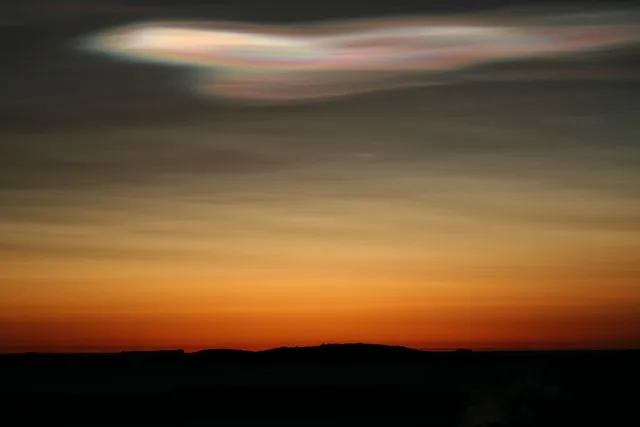
Meteorologist Renae Baker captured the stunning photos at an Australian base. The phenomenon can rarely be seen.
Via Clarín
Some of the coldest temperatures on Earth have caused a singular cloud formation over the Australian Mawson station in Antarctica, a group of scientists said on Tuesday.
Meteorologist Renae Baker took spectacular images of the nacreous clouds, also known as polar stratospheric clouds, on July 25.
These clouds only form at high polar latitudes in winter and require temperatures below minus 80 degrees Celsius. A weather balloon measured temperatures as low as minus 87 degrees Celsius on the day the photos were taken.
"Surprisingly, the winds at that altitude were blowing at about 230 kilometers per hour," Baker said on the Australian government's Antarctic Division website.
Reflecting light like an airborne mother-of-pearl shell, the clouds acquire a particular coloration when the sun's rays pass through the ice crystals along with a jet of stratospheric air more than 10 kilometers above the surface.
Scientist Andrew Klekociuk, of the Antarctic Division, said the clouds are rarely seen but can have lasting effects.
"These clouds are more than a simple curiosity," he said. "They reveal extreme conditions in the atmosphere and promote chemical changes that lead to the destruction of vital stratospheric ozone."
"We are using ground-based instruments, balloons and satellites in an international program to detect what this type of phenomenon reveals to us about the current and future state of the climate."
(Source: AP)