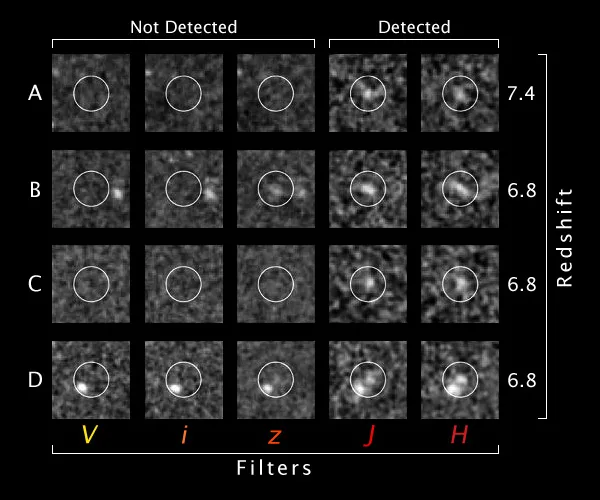
Astronomers, analyzing two of the deepest fields of the cosmos with the space telescope have found a gold mine of galaxies, more than 500 that existed less than a billion years after the Big Bang. These galaxies existed when the cosmos was less than 7 percent of its current age of 13.7 billion years.
Via HubbleSite
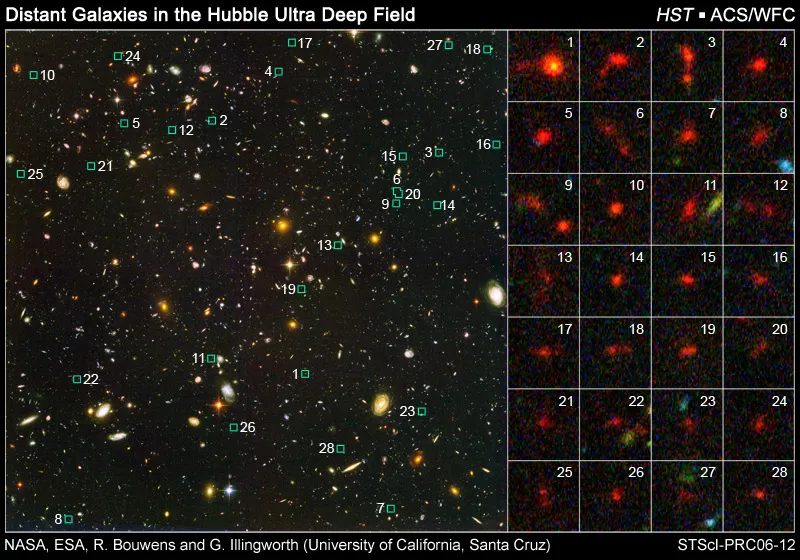
Distant Galaxies in the Hubble Ultra Deep Field
This discovery is scientifically invaluable for understanding the origin of galaxies, considering that only a decade ago the early formation of galaxies was an unexplored territory. Astronomers had not even seen a single galaxy that existed when the universe was so young, so finding 500 is a significant step for cosmologists.
These galaxies revealed by Hubble are smaller than today's giants, they are very bluish indicating that they are flares of star births. The images appear in red due to their tremendous distance from Earth. The blue light from their young stars took 13 billion years to reach our planet. During the journey, the blue light was shifted to red by the expansion of space.
"Finding so many of these dwarf galaxies, but only a few bright ones, is evidence of galaxy formation through small pieces - merging, as predicted by the theory of galaxy formation," said astronomer Rychard Bouwens of the University of California, Santa Cruz, who led the Hubble study.
Bouwens and his team studied these galaxies in an analysis of the Hubble Ultra Deep Field (HUDF), completed in 2004, and the Great Observatories Origins Deep Survey (GOODS), done in 2003. The results were presented on August 17, 2006, at the General Assembly of the International Astronomical Union, and will be published in the November 20 edition of Astrophysical Journal.
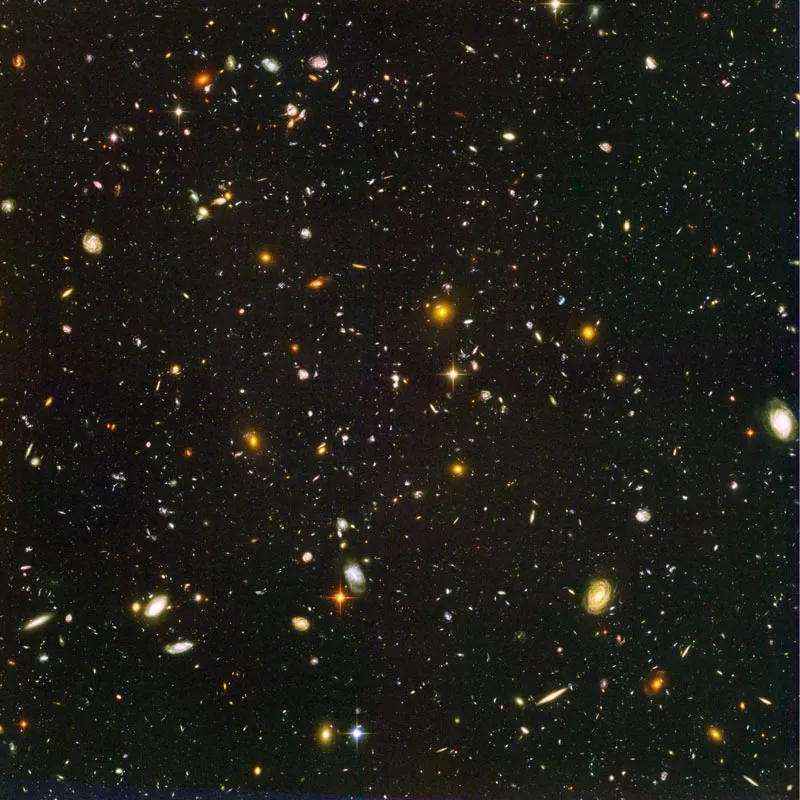
The Hubble Ultra Deep Field
Image Type: Astronomical/Illustration
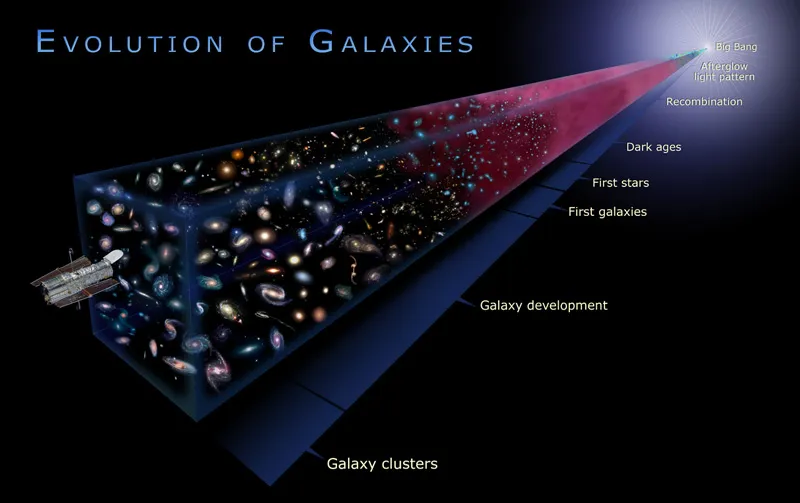
Evolution of Galaxies
Image Type: Astronomical/Illustration
For more information, contact:
Rychard Bouwens, University of California, Santa Cruz, California,
(phone) 831-459-5276, (e-mail) [email protected]
Garth Illingworth, University of California, Santa Cruz, California,
(phone) 831-459-2843, (e-mail) [email protected]
John Blakeslee, Washington State University, Pullman, Washington,
(phone) 509-335-2414, (e-mail) [email protected] and
Marijn Franx, Leiden Observatory, Leiden, Netherlands,
(phone) 011-31-71-5275870, (e-mail) [email protected]
Other related news:
A team of scientists claims to have discovered the most distant galaxy in the Universe
Tracking the evolution of the first galaxies in the Universe
My Cosmology news on de.icio.us
HubbleSite more news releases:
About Cosmology > Distant Galaxies
About Cosmology > Universe: Age/Size
About Survey > Hubble Ultra Deep Field
From 2006