REPORT: 2006 NOBEL PRIZE IN PHYSICS
The results from the 'COBE' satellite shaped modern cosmology
Scientists from the United States have swept this year's Nobel Prizes in Science. One of the country's most important universities, Stanford, has taken two of the five awards, one in Medicine and one in Chemistry. The dominant position of the United States in current science has been made clear. In physics, work from 1992 has been awarded, some observations of the sky that gave essential support to the Big Bang theory about the history of the universe, opening a whole path to the very active precision cosmology of today. In Chemistry and Medicine, much more recent work has been distinguished, both related to a key compound of life, RNA.
Via El País
By ENRIQUE MARTÍNEZ G.
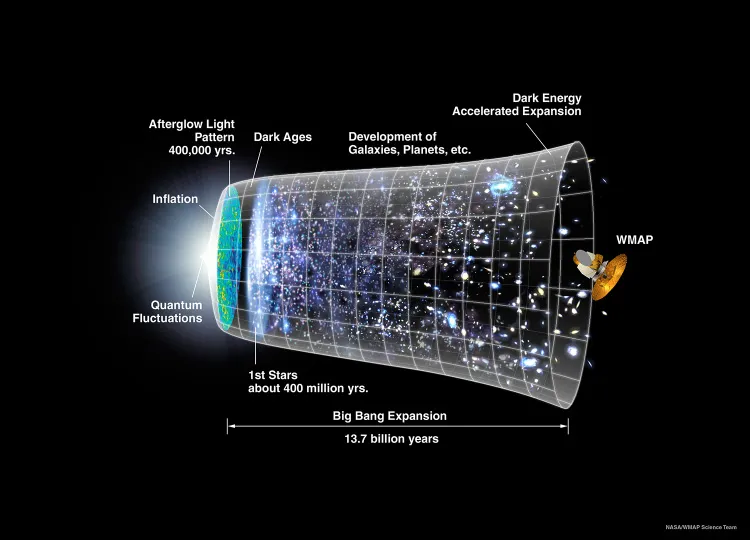
The radiation from the Cosmic Microwave Background has played and continues to play a decisive role in understanding our universe. According to the standard Big Bang model, its age is about 13,700 million years. In its remote past, it went through a very dense and hot state, experiencing a rapid expansion. It was filled with elementary particles, including electromagnetic radiation (like visible light), in continuous interaction and distributed very uniformly throughout space.
About 380,000 years after the Big Bang, that radiation had cooled due to the expansion, to such an extent that it no longer had enough energy to ionize hydrogen atoms. From this moment on, the radiation separates from the rest of the particles and can move freely through the universe. This radiation, which we can observe today in the microwave range, with a temperature of about 270 degrees Celsius below zero, and which contains very valuable information from the earliest epochs of the universe, is what is known as the Cosmic Microwave Background.
Before explaining the cosmological implications of the recent findings in more detail, it is interesting to put them in a historical context. The discovery of the very existence of the background radiation occurred by chance in 1964 by two engineers from the Bell Laboratories of the American telephone company ATT, while they were trying to understand the source of a noise that appeared in their radio receivers (paradoxically, the discovery of this noise also made them worthy of the Nobel Prize in Physics, in 1978).
The discovery of this radiation, which had been theoretically predicted in the late forties, meant that most of the scientific community accepted the Big Bang model as opposed to the then competing steady-state model (according to which the universe, although expanding, maintained the same appearance due to the continuous formation of new matter).
If the mere detection of the background radiation could only be carried out almost 20 years after its theoretical prediction within the Big Bang model, due to the weakness of its signal, the most precise measurement of its energy distribution both in wavelength and spatially, turned out to be a real challenge for astrophysicists.
The task was even more complicated if we consider that the cosmological signal was mixed with other astrophysical emissions, produced by our galaxy and by other galaxies. Furthermore, its observation from the ground was limited to narrow windows in the microwave range since the atmosphere emits and absorbs in that range. This required looking for extremely dry places or, even better, mounting experiments on board stratospheric balloons or artificial satellites that completely avoided the atmospheric presence.
In the early nineties, two instruments on board NASA's COBE (Cosmic Background Explorer) satellite gave rise to two key results that shaped modern cosmology: the energy distribution in wavelengths of the cosmic background radiation corresponded to that of a black body (a body that absorbs all radiation that reaches it and emits with a characteristic distribution) at a temperature of approximately 270.37 degrees below zero, and the anisotropies (differences between two directions in the sky) in the temperature of that radiation, which had a typical amplitude of one part in 100 thousand, on angular scales of about 10 degrees.
The first result, obtained by the FIRAS (Far-Infrared Absolute Spectrophotometer) experiment and whose principal investigator was John Mather of NASA, demonstrated unequivocally that the cosmic radiation came from a dense and hot past of the universe. The second, obtained through the DMR (Differential Microwave Radiometers) experiment and whose principal investigator was George Smoot of the University of California at Berkeley, established for the first time the connection between the anisotropies of the cosmic background and the large-scale structure of the universe.
In other words, the imprint of the initial seeds in the distribution of matter, which gave rise through gravitational collapse to stars, galaxies and agglomerations of galaxies (called clusters and superclusters), was imprinted on the anisotropies of the background radiation as a consequence of the initial interaction in the primordial plasma (and as the Big Bang model in turn predicted). It is these results that have made both scientists worthy of this year's Nobel Prize in Physics.
Recently several experiments (especially NASA's WMAP satellite currently in operation) have confirmed the COBE-DMR observations, improving those measurements both in sensitivity and resolution. These results in the field of the microwave background complement very well other cosmological observations based on the large-scale distribution of galaxies, or on the magnitude-redshift relation of supernovae, jointly supporting the standard model of the universe.
This great advance in our observation of the universe has only been possible due to the rapid development of instruments very sensitive to radiation, across the entire wavelength range from radio to X-rays. This has allowed, on the one hand, to verify the standard model through totally independent cosmological observations, and on the other, our entry into what has been called the era of precision cosmology.
Some members of the Spanish scientific community, mainly at the Instituto de Astrofísica de Canarias, the Universities of Cantabria, Granada and Politécnica de Cataluña and the Instituto de Física de Cantabria, are following in COBE's footsteps through our participation in the construction of two experiments for the future satellite of the European Space Agency's (ESA) scientific program, Planck, which will be launched in 2008. In this future mission we are working alongside Smoot, among other European and American scientists.
Planck will be the third satellite dedicated to observing the cosmic background, and will make an almost perfect measurement of the anisotropies in temperature, reducing current errors in the cosmological parameters that characterize the universe by about 10 times. It will also measure the anisotropies in the polarization (a property of electromagnetic waves by which, for example, sunglasses block ultraviolet light) of the radiation background, which constitutes a unique fingerprint of the presence of gravitational waves in the first instants of the universe. Who knows if this or other future satellites currently under study will achieve similar milestones in our knowledge of the universe, unveiling the other secrets that this radiation still hides.
Enrique Martínez González is a researcher at the Instituto de Física de Cantabria (CSIC-Universidad de Cantabria).