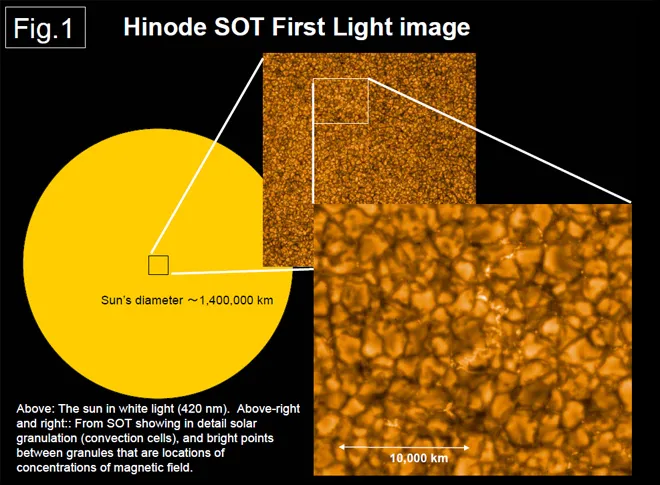
Japan's recently launched Hinode spacecraft has captured its first images of the sun. Known before as Solar-b, the spacecraft launched on September 22, and opened its instruments in space on October 23, 2006. This image demonstrates the granules on the Sun's surface, each of which is thousands of kilometers.
Via UniverseToday
The Solar Optical Telescope (SOT) aboard Japan's Hinode spacecraft has opened its doors and begun photographing. Shown below is a "first light" image taken on October 23. The light and dark bubbles are solar granules, masses of hot gas that rise and fall like water boiling on a hot stove. Each granule is the size of a terrestrial continent. SOT has no problem seeing such detail from Earth orbit—93 million miles away.
"We have confirmed that SOT is achieving a very high spatial resolution of 0.2 arcseconds, a primary goal of the instrument," says Japan's Aerospace Exploration Agency (JAXA) in a statement released October 31. An arcsecond is an angle equal to 1/3600 of a degree—or the width of a human hair seen from about thirty feet away.
Hinode (Japanese for sunrise, known before as Solar B) was launched on September 22 from the Uchinoura Space Center in Kyushu, Japan. "It is on a mission to study the sun's sunspots, which give rise to powerful flares and solar storms," says John Davis, NASA's Solar-b project scientist at NASA's Marshall Space Flight Center. Astronomers have been studying sunspots since the days of Galileo four hundred years ago, but they still cannot predict flares. Hinode's data may solve the mystery.
Hinode carries three advanced space telescopes:
The Solar Optical Telescope (SOT) provides clear images of features on the sun's surface. A magnetograph attached to the SOT will be able to trace the magnetic fields of sunspots, which harbor the energy for explosive flares.
The X-Ray Telescope (XRT) can see the hot gas of sunspots and floating in the sun's atmosphere, the corona. For reasons no one understands, the Sun's corona is much hotter than its surface—another mystery Hinode may help unveil. First light for the XRT was achieved on October 25: image.
The Extreme ultraviolet Imaging Spectrometer (EIS) is a device that can tune into specific spectral lines emitted by ions in the sun's atmosphere. By looking at these lines back and forth (the Doppler shift), astronomers can track solar material as it moves around. EIS's dynamic movies will not only entertain, but also provide crucial clues to solving the dual mystery of flares and coronal heating. First light for the EIS was obtained on October 28.
During the month ahead, mission controllers and scientists want to "progress in testing the basic operation of these telescopes to implement full scientific operations," according to JAXA. In December 2006 "we plan to release a summary of the initial scientific results obtained from the test images." And then the regular flow of fantastic images will begin.
Original source: Science Nasa