A team of researchers from around the world, led by Mariano Moles (Instituto de Astrofísica de Andalucía, CSIC), is carrying out a large-scale cosmic survey (called the ALHAMBRA survey) at Calar Alto, which will cover an area of four square degrees in 8 regions of the sky, in both visible and near-infrared wavelengths. This project, when completed, will become the reference work on the history of the universe.
Via Observatorio Calar Alto
Cosmic tomography
In astronomy, when observing faint and distant objects, we see them as they were in the remote past. These bodies are detected not as they are today, but with the appearance they had when they emitted the light that reaches us now from them. It is possible to obtain images of the infancy of the universe by looking at the most distant objects. Hence the interest of modern astronomy in probing the cosmos in search of the faintest, most distant objects. Thus, by studying successively more distant galaxies, the history of the cosmos can be traced.
But to achieve a good representation of each stage of the universe's history, it is necessary to have a considerable number of objects in each distance interval (that is, in each age interval). That is why it is not enough to take a very deep image, but it is also necessary to cover a wide region (as large a portion of the sky as possible) to ensure that each stage of the cosmos's life is represented by a significant population of objects that allows for statistically relevant results to be deduced.
In recent years, several cosmological surveys have been undertaken that have reached extremely far covering small celestial areas. Other studies have covered very wide portions of the sky but without reaching too great distances. ALHAMBRA was designed to fill the existing gap between studies that cover a tiny portion of the sky, like the Hubble Space Telescope's "Deep Fields," and those that collect a large area but are shallow, and therefore only allow describing the local, relatively bright universe. The name ALHAMBRA corresponds to the English acronym "Advanced Large, Homogeneous Area Medium Band Redshift Astronomical survey," that is, "Advanced, Large, Homogeneous Area Medium Band Redshift Astronomical survey."
ALHAMBRA covers a fraction of the sky equivalent to 20 times the area of the full Moon. We must keep in mind that all the deep fields taken by the Hubble Space Telescope cover an area 500 times smaller. At the same time, the depth of ALHAMBRA (that is, the distance reached) allows reconstructing 90% of the history of the universe. With a sample of this size and depth, phenomena associated with the origin and evolution of different celestial bodies can be observed and measured, as well as the appearance and development of the different types of galaxies we observe today. Furthermore, eight separate areas of the sky have been chosen for the study, to account for possible local heterogeneities, the so-called cosmic variance, and give general validity to the result.
Light and color
As Isaac Newton discovered in the 17th century, white light, when passing through a glass prism, decomposes into a series of colors. Today we accept the convention that the rainbow has seven colors, precisely because Newton decided to describe them that way. In reality, the spectrum of light is continuous, and we could identify thousands of different colors in it, if we had names for them. In the case of the ALHAMBRA project, whose primary objective is to determine the nature and distance of the largest possible number of celestial objects, it has been shown that to optimize the results in terms of quantity and precision, it is necessary to divide the visible spectrum into 20 bands of equal width, we could say into 20 colors. For this, 20 different filters are used, designed expressly for this program, ranging from violet to red, and in three bands the infrared spectrum. Therefore, this project requires recording each observed field a minimum of twenty times in the visible spectrum (with the LAICA camera), and three times in the infrared (with OMEGA-2000), which implies an enormous observational effort.
The image
With the first fields completed, the images from the ALHAMBRA project obtained with the 3.5 m telescope at Calar Alto reveal the spectacular power of this survey for its central scientific objective: studying cosmic evolution. The image accompanying this note corresponds to a region 15 minutes on a side (1/3 the area of the full Moon), from one of the fields observed with the LAICA camera. In this image appear around 10,000 objects. Most of them are remote galaxies, but there are also quasars, active galaxies, foreground stars from our own Galaxy, and even Solar System objects (asteroids and perhaps trans-Neptunian objects).
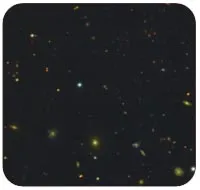
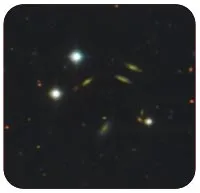
Enlargement of two small portions (2.5 arcminutes and 2 arcminutes, respectively) of the full image (15 arcminutes), in the constellation Pegasus, published by the ALHAMBRA team.
© M. Moles / ALHAMBRA Team / V.Peris
The previous figure shows enlargements of the original image that allow one to intuit the quantity and diversity of extragalactic objects detected, some 100 million times fainter than the faintest stars that can be perceived with the naked eye. By having data in 23 different filters, it will also be possible to characterize them and determine the distance to many of them. This measurement is obtained with unprecedented precision in a project that uses only images, without resorting to spectra.
When the ALHAMBRA database is complete it will contain, as can be deduced from the results found with the first images and in agreement with the calculated precisions, about 650,000 galaxies and approximately 5,000 quasars and active galactic nuclei, with precise measurements of their distances. ALHAMBRA will constitute an unparalleled tool for the study of cosmic evolution: the passage of the universe from being an ocean of neutral gas, with small zones of density higher than the average gravitationally bound, to a bustling hive of stars and black holes, and up to the relatively tranquil cosmos of today, populated by clusters, galaxies, stars and planets like ours.
The ALHAMBRA team uses the LAICA (in the visible) and OMEGA-2000 (in the near infrared) cameras, both coupled to the 3.5 m telescope of the Calar Alto Observatory in Almería (Spain).
The ALHAMBRA research team is led by Mariano Moles (Instituto de Astrofísica de Andalucía, IAA) and comprises more than fifty scientists organized into an extended team and a core team. The current members of the latter are Mariano Moles (IAA), Emilio Alfaro (IAA), Narciso Benítez (IAA), Tom Broadhurst (Rahca I. Physics, Israel), Francisco Javier Castander (Institut d'Estudis Espacials de Catalunya), Jordi Cepa (Instituto de Astrofísica de Canarias, IAC), Miguel Cerviño (IAA), Alberto Fernández Soto (Universitat de València, UV), Rosa González Delgado (IAA), Leopoldo Infante (Pontifica Universidad Católica, Chile), José Alfonso López Aguerri (IAC), Isabel Márquez (IAA), Vicent J. Martínez (UV), Josefa Masegosa (IAA), Ascensión del Olmo (IAA), Jaime Perea (IAA), Francisco Prada (IAA), José María Quintana (IAA), Sebastián Sánchez (Centro Astronómico Hispano-Alemán).
High-resolution images:
High-resolution version of the fragment shown in ten different filters (30 kB)
High-resolution version of the enlarged 2.5 arcminute fragment (132 kB)
High-resolution version of the enlarged 2 arcminute fragment (50 kB)
Color high-resolution image of the ALHAMBRA field F08_01_1. (1.1 MB). This image, covering 15x15 arcminutes, contains light captured in 14 of ALHAMBRA's 23 filters, between 396 and 799 nm. The goal of the processing applied to this image is to emulate the color with which the human eye would see the objects in it; for this, a different color hue has been assigned to each filter, guided by the eye's sensitivity curves (taking filters between 700-800 nm as pure red). By integrating the 14 images, the result is a photograph reduced to the three primary colors (red, green, and blue). All processing has been carried out with the PixInsight Standard program.
More information:
Official ALHAMBRA page (in English)
ALHAMBRA survey press release