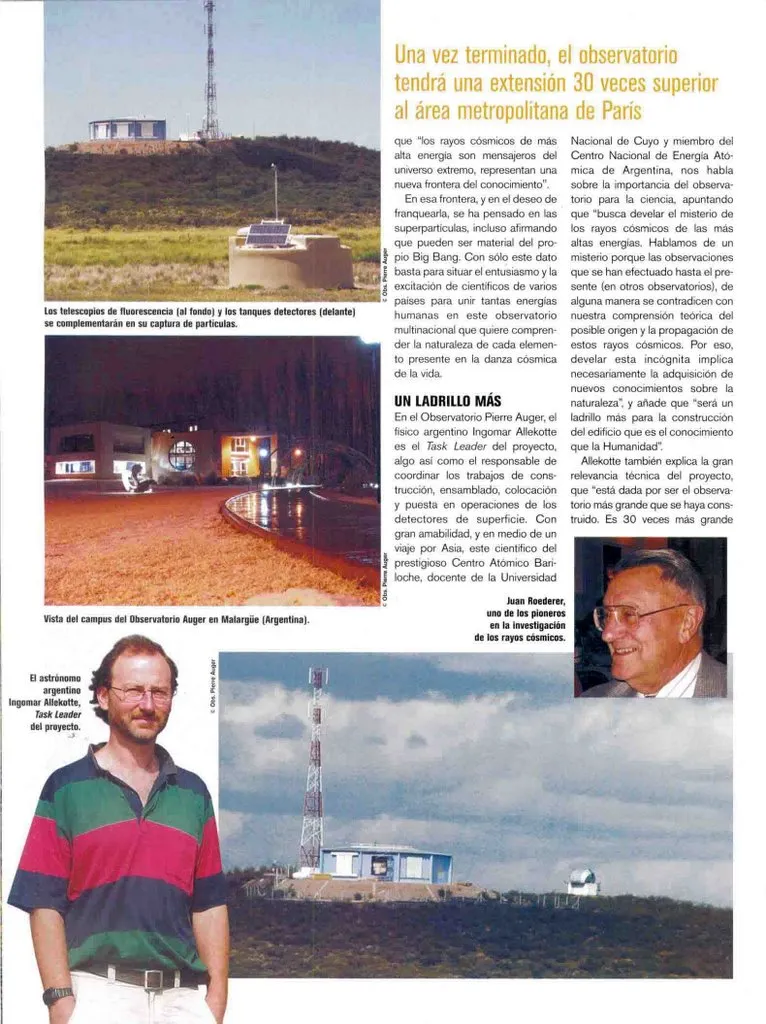
Across 3,000 km2 of the Argentine province of Mendoza stretches the world's largest observatory, designed to capture information about one of the enigmas of Physics: the nature of the highest-speed particles captured to date, ultra-high-energy cosmic rays. Through 1,600 detector tanks, 24 fluorescence telescopes, and the work of hundreds of scientists from around the world, it is hoped to achieve elementary results for the evolution of human knowledge.
By Diego Oscar Ramos (Buenos Aires) in Revista Espacio No. 16
In times when scientific knowledge seems constantly exposed to acceleration and movement, it is estimated that a number close to 10,000 are the particles that penetrate per second into each square meter of the upper layers of the atmosphere. The highest-energy particles are the least detected, being an extremely curious phenomenon, since their place of origin and the way they achieve speeds greater than any natural phenomenon we know are unknown.
At least, this low detection frequency is expected to vary notably with the start-up of the Pierre Auger Observatory, which has already begun to perform detections and is firmly on its way to completion. Its name pays homage to the French scientist who, in 1938, gave the world his theory of the cascade of millions of ultra-energetic particles that usually arrive habitually on Earth.
"FISHING" NETWORKS
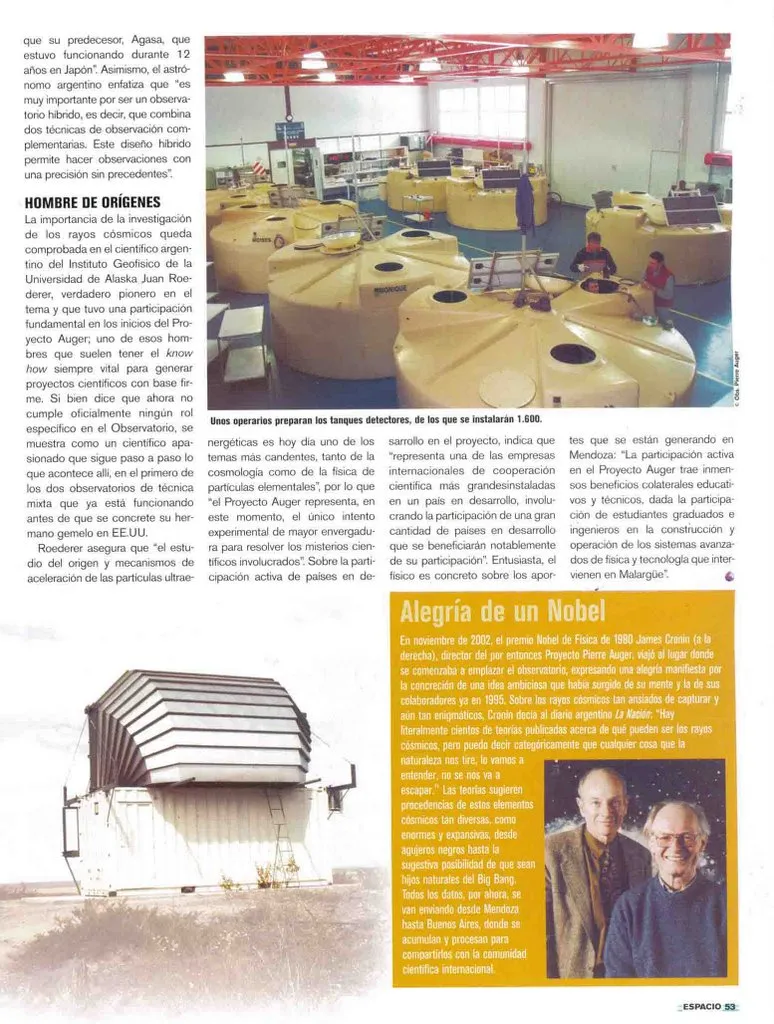
Already in 2002, just two years after its formal start, the observatory successfully tested the operation of its technology, and it is expected that by 2007 the 1,600 particle detectors installed at 1,400 meters above sea level in the province of Mendoza will be active. The project is being located here, with an estimated cost of 41 million euros, to detect the mysterious particles in a capture system as complex as it is simple, since the principle of action is the same as a net, where each point of the mesh is a water tank barely two meters in diameter, with an antenna and a solar panel, separated from each other by a distance of 1.5 kilometers.
In that mesh, the traces that show these cosmic rays have passed through the Earth's atmosphere will be "fished," because what reaches our detectors are the specific particles generated by that entry collision into our environment, and not the cosmic rays themselves. With this procedure, it is hoped to fish in those waters valuable information from about 30 cosmic rays per year, a fairly high number if one considers that the previous average, already proposed in 1992 by the 1980 Nobel Prize in Physics, Jim Cronin, was a similar number, but detected throughout the century.
"We can analyze how many there are, the shape of their spectrum, measure the direction they come from in the galactic sky and their composition, whether they are protons or heavy nuclei," Cronin declared in Argentina during a visit to the Observatory in November 2005, when he stated that "if one wants to make good measurements, one must have the best possible apparatus." Therefore, with full confidence in the generated work team and the complementary technology, which includes large fluorescence telescopes that complete the data provided by the tanks, by detecting the ultraviolet light from nitrogen molecules, he assured that "the highest-energy cosmic rays are messengers from the extreme universe, they represent a new frontier of knowledge."
At that frontier, and in the desire to cross it, superparticles have been considered, even stating that they could be material from the Big Bang itself. With just this fact, it is enough to place the enthusiasm and excitement of scientists from several countries to unite so much human energy in this multinational observatory that wants to understand the nature of each element present in the cosmic dance of life.
ONE MORE BRICK
At the Pierre Auger Observatory, Argentine physicist Ingomar Allekotte is the Task Leader of the project, something like the person responsible for coordinating the construction, assembly, placement, and commissioning of the surface detectors. With great kindness, and in the middle of a trip through Asia, this scientist from the prestigious Bariloche Atomic Center, professor at the University
Nacional de Cuyo and member of the National Atomic Energy Commission of Argentina, speaks to us about the importance of the observatory for science, pointing out that "it seeks to unveil the mystery of cosmic rays of the highest energies. We speak of a mystery because the observations that have been made to date (in other observatories), in some way contradict our theoretical understanding of the possible origin and propagation of these cosmic rays. Therefore, unveiling this unknown necessarily implies the acquisition of new knowledge about nature," and adds that "it will be one more brick for the construction of the building that is the knowledge of Humanity."
Allekotte also explains the great technical relevance of the project, which "is given by being the largest observatory ever built. It is 30 times larger than its predecessor, Agasa, which operated for 12 years in Japan." Likewise, the Argentine astronomer emphasizes that "it is very important for being a hybrid observatory, that is, one that combines two complementary observation techniques. This hybrid design allows observations with unprecedented precision."
MAN OF ORIGINS
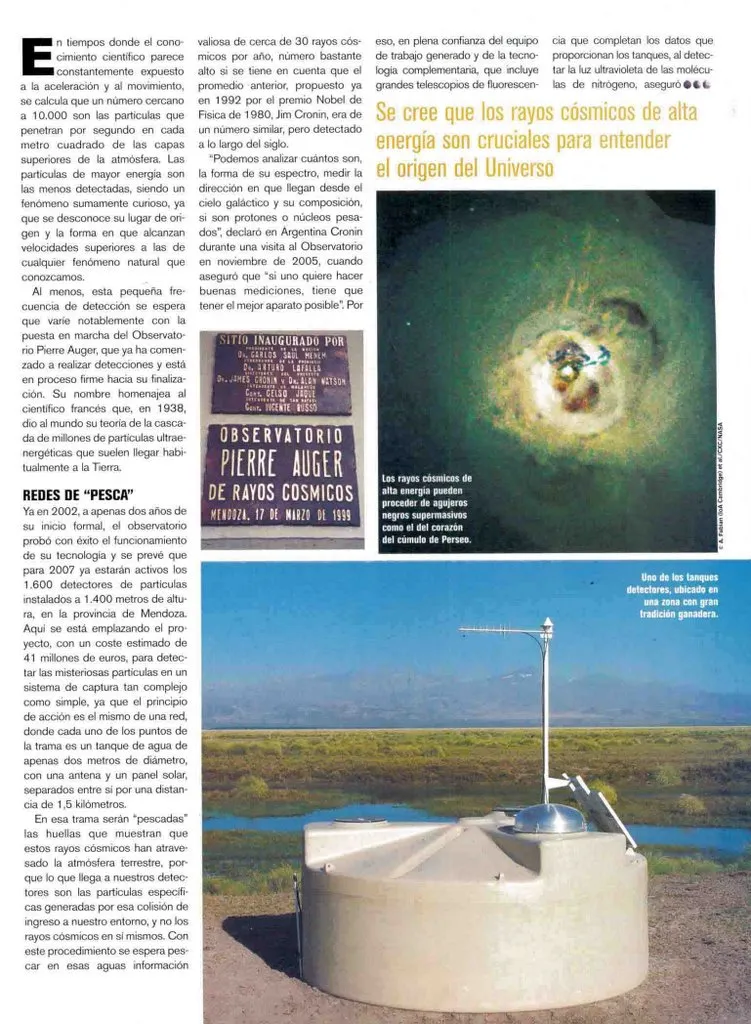
The importance of cosmic ray research is proven in the Argentine scientist from the Geophysical Institute of the University of Alaska Juan Roederer, a true pioneer on the subject who had a fundamental participation in the beginnings of the Auger Project; one of those men who often have the know-how always vital for generating scientific projects with a firm base. Although he says he now officially holds no specific role at the Observatory, he presents himself as a passionate scientist who follows step by step what happens there, in the first of the two mixed-technique observatories that is already operating before its twin brother in the U.S. is realized.
Roederer states that 'the study of the origin and acceleration mechanisms of ultraenergetic particles is today one of the hottest topics, both in cosmology and in elementary particle physics,' and therefore 'the Auger Project represents, at this moment, the only major experimental attempt to solve the scientific mysteries involved.' Regarding the active participation of developing countries in the project, he indicates that 'it represents one of the largest international scientific cooperation enterprises installed in a developing country, involving the participation of a large number of developing countries that will benefit notably from their involvement.' Enthusiastic, the physicist is concrete about the contributions being generated in Mendoza: 'Active participation in the Auger Project brings immense collateral educational and technical benefits, given the involvement of graduate students and engineers in the construction and operation of the advanced physics and technology systems involved in Malargüe.'
----------------
Joy of a Nobel
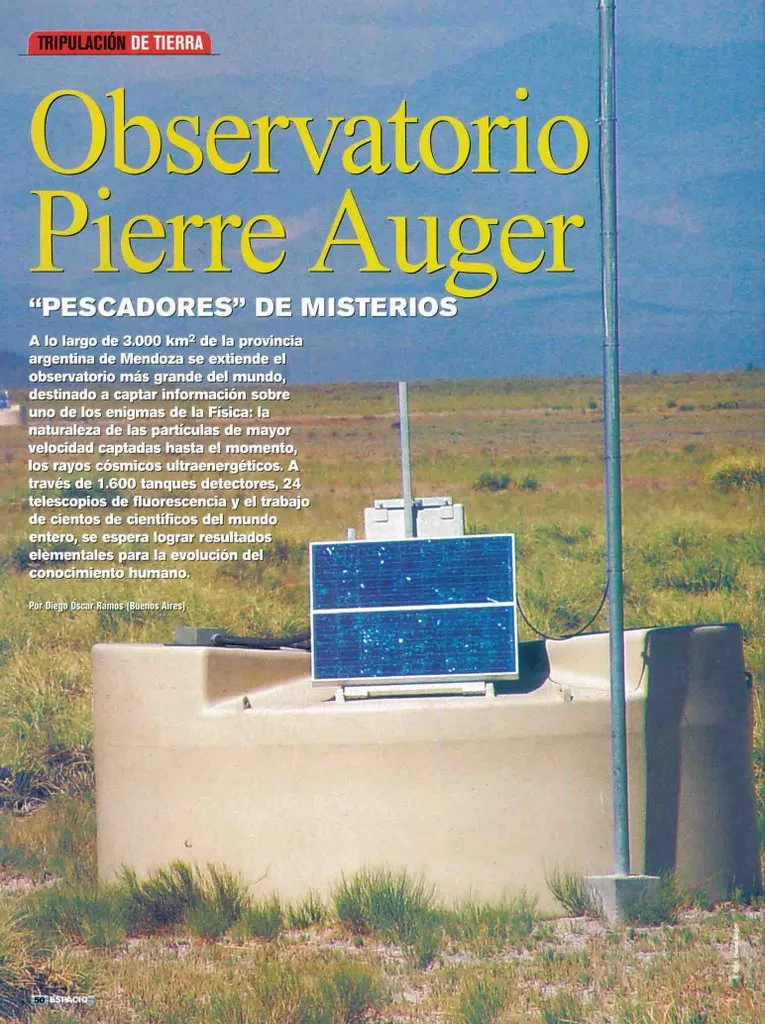
In November 2002, the 1980 Nobel Prize in Physics winner James Cronin (on the right), director of what was then the Pierre Auger Project, traveled to the site where the observatory was beginning to be set up, expressing a manifest joy for the realization of an ambitious idea that had emerged from his mind and that of his collaborators back in 1995. About the cosmic rays so eagerly sought to capture and still so enigmatic, Cronin told the Argentine newspaper La Nación: 'There are literally hundreds of published theories about what cosmic rays could be, but I can say categorically that whatever nature throws at us, we are going to understand it, it will not escape us.' The theories suggest origins for these cosmic elements as diverse as they are enormous and expansive, from black holes to the suggestive possibility that they are natural children of the Big Bang. All the data, for now, is being sent from Mendoza to Buenos Aires, where it is accumulated and processed to be shared with the international scientific community.
----------