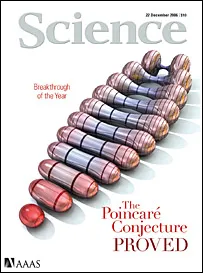
The solution to one of the most difficult mathematical problems was the most important scientific advance of 2006, according to the prestigious journal Science.
Via BBC
Paul Rincon
BBC
Grigori Perelman, who solved the century-old Poincaré Conjecture, caused a sensation not only when he solved the problem, and not only because of the quality of his work.
In August, the Russian became the first person to reject the Fields Medal, considered the Nobel Prize of mathematics.
Perelman also appears set to reject a million-dollar prize offered by a U.S. mathematics institute.
Perelman is said to hate publicity and is described as isolated from the rest of the mathematical community.
But his work has aroused much attention in the field, and also controversy.
Terence Tao, a mathematics professor at the University of California, Los Angeles, said Perelman's solution "is the best piece of mathematics we have seen in the last 10 years".
Timofey Shilkin, a former colleague of Perelman's at the Steklov Mathematical Institute in St. Petersburg, told the BBC: "He definitely deserves the Fields Medal. That is my personal opinion. I am completely sure he is a genius".
"Excellent mathematician"
"I'm afraid he is quite a hermit. We know the same about him as you do: not too much," added Shilkin.
"I met him when he was a member of our group and we had contact once a week, but only short conversations."
"I know nothing about his personal life; I only know he is an excellent mathematician," Shilkin stated.
Perelman left the Steklov Institute in January, and the last thing known about him is that he is unemployed and lives with his mother in her apartment in St. Petersburg.
For many years he worked, it is believed, solely on the Poincaré Conjecture. Then, in 2002, he published on the Internet the first of three papers outlining his solution to the problem.
The conjecture is a central topic in topology, the study of the geometric properties of objects that do not change when they are stretched, distorted, or shrunk.
The surface of the Earth is what topology describes as a two-dimensional sphere. If one wanted to tie it with a rope, it could be tightened to a certain point.
On the surface of a doughnut, however, a rope passing through the hole in the center cannot be tightened without, at a certain point, cutting the surface.
Verification
Since the 19th century, mathematicians have known that the sphere is the only closed two-dimensional space that has this property, but they were unsure about objects with more dimensions.
The Poincaré Conjecture states that a three-dimensional sphere is the only closed three-dimensional space without holes.
Mathematicians found no proof of this conjecture until Perelman published his work on the arXiv.org site.
This site is a place where scientists send drafts of their work for preliminary criticism, before submitting them to the journals of each discipline.
An internal academic battle within the mathematics community now threatens to overshadow Perelman's achievement.
What the Russian achieved was to remove the main obstacle that prevented proving the conjecture. Then, the task of verifying his evidence was left to others.
It was at this point in the process - when mathematicians inspected Perelman's work to assess its accuracy - that resentment began to emerge.
"Complete proof"
In 2005, a Chinese team led by Huai-Dong Cao of Lehigh University and Xi-Ping Zhu of Zhongshan University published what they said was "the first complete written proof of the Poincaré Conjecture".
Cao and Zhu dedicated themselves to verifying Perelman's work, under the guidance of their mentor Shing-Tung Yau, a Chinese mathematics professor at Harvard University in the United States.
Shortly after the publication of Cao and Zhu's paper, Yau gave a speech in which he allegedly said: "In Perelman's work, many key ideas of the proofs are sketched or outlined, but the complete details of the evidence often do not exist".
This aroused the anger of his colleagues, who said that Yau's promotion of his protégés had gone too far.
In a unique interview, Perelman told The New Yorker magazine: "It is not clear to me what contribution they made".
However, speaking with The New York Times in October, Yau denied that he had said there were gaps in Perelman's work.
The journal Science also named the "embarrassment" of the year: the scandal involving South Korean cloning pioneer Hwang Woo-suk. His report on the production of stem cells from a cloned human embryo was found to be fabricated.
Scientific advances of 2006
1. The Poincaré Conjecture. Russian mathematician Grigori Perelman apparently solves the famous mathematical problem.
2. Discovering fossil DNA. Researchers use new techniques to discover the sequence of more than a million bases of nuclear DNA in a Neanderthal.
3. Shrinking ice. Scientists discover that the world's two great ice sheets are melting at an accelerating rate.
4. From sea to land. Details are published of a 375-million-year-old fish that fills a gap in the evolution between sea creatures and land animals.
5. Perfect camouflage. British and American scientists create a "cloak" that makes objects invisible to microwaves.
6. Ray of hope. Medical trials show that the drug ranibizumab improves the vision of about one-third of patients with a disease that gradually degenerates vision.
7. The path of species. A study of flies and butterflies helped understand the way species arise.
8. Beyond the light barrier. New microscopic techniques allow biologists a better view of the fine structure of cells and proteins.
9. The persistence of memory. Neuroscientists discover how the brain records new memories.
10. Small molecules. Researchers report on a new type of small RNA molecules that shut down gene expression.