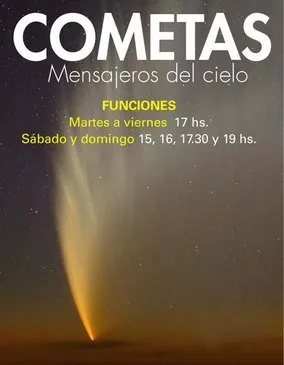
The brightest comet in the last 40 years will be visible to the naked eye and across the country starting tomorrow, after sunset.
Via Abierta.tv
The "Great Comet Mc Naught" will begin to be visible to the naked eye from this Wednesday around 20:30, when it will be positioned at a very low altitude above the South-Southwest horizon, and it can be observed until the end of the month, although with decreasing intensity.
It can be observed with the naked eye from any point in Argentina, although it will be necessary to be in high or clear places that allow viewing without obstacles, while the Buenos Aires Planetarium recommended the use of binoculars.
The "time window" to see it will be one hour, as around 21:30 the comet will begin to hide on the horizon. "The comet will be seen in the southwestern sky after sunset, between 20:15 and 20:30, at a low altitude above the horizon, easily observed as a patch of light accompanied by a diffuse tail," explained Mariano Ribas, coordinator of the Astronomy area of the Buenos Aires planetarium.
"It is the most important comet since 1965, when Ikeya Seki was seen, the largest of the entire century," he said regarding this "surprise comet" that no one expected, because although it was discovered in August 2006 it gradually acquired its current brightness over the months.
"No one expected it to behave as it ended up behaving," explained Ribas, and stated that the comet will increase its altitude above the evening horizon as the days pass, making it easier to locate.
The comet will begin to lose brightness, very slowly, as it moves away from the Sun and Earth, although scientists are confident it will be visible to the naked eye at least until early February.
The Palermo Planetarium will organize three special, public and free sessions to observe the phenomenon with telescopes during this weekend.
Friday, Saturday and Sunday from 20:15 until 21:00, when the comet will no longer be visible from the planetarium park, the spectacle can be observed, provided the sky is clear.