Scientists are confident they will boost understanding of the universe with advanced experiments
Via El País
ALICIA RIVERA - Madrid - 01/10/2007
With the close and fruitful alliance of astronomy and particle physics, forged a few years ago, scientists are preparing new experiments and observatories to make a qualitative leap in their understanding of the cosmos. "We know a lot about the universe, but we don't understand it that much," says theoretical physicist Michael Turner (University of Chicago), who foresees "a boost in our understanding of both the universe and the laws that govern it, which places cosmology on the brink of a golden age" that will blossom in 15 years. The trick of this alliance of the largest and the smallest lies in the fact that, to explain things like black holes or the formation of galaxies, scientists apply the deep physical mechanisms revealed in the realm of elementary particles and their interactions. At the same time, they use the universe as a laboratory for phenomena that, for now, they cannot replicate on Earth.
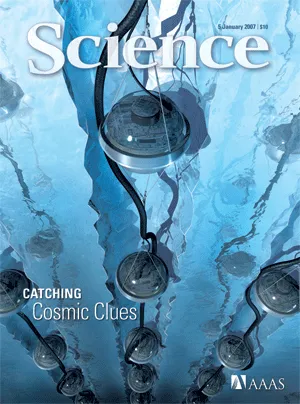
Six specialists explain the experimental pillars on which they base this optimism in the latest issue of the journal Science. Next-generation neutrino telescopes to see the universe from the bottom of water or Antarctic ice, cosmic ray and gamma-ray observatories are key instruments that scientists will exploit in a few years. Scientists and institutions from Spain are participating in several of them.
Before breaking down the ideas and the new means in perspective to verify them, Turner reviews what is already known about the universe, which is much more than people think and much less than experts would like. It has been determined that the cosmos is 13,700 million years old (with a 1% error), that it is spatially flat and that its expansion from the initial Big Bang is accelerating. Turner gives as an approximate composition: atoms (4%), dark matter (about 20%) and dark energy (76%), with their corresponding margins of error. This very week, the first three-dimensional map of a relatively large area of the sky that incorporates the distribution of dark matter was made public. Stars, what is traditionally seen in the sky, account for 1% of that 4% of atoms or known normal matter, to which neutrinos must be added (maximum, 1%).
"Neutrinos have the potential to be ideal cosmic messengers," says Francis Halzen (University of Wisconsin). These particles without electric charge are produced, for example, in the nuclear reactions inside the Sun, and 100,000 million solar neutrinos reach Earth per second per square centimeter, but they barely interact with matter. This has the disadvantage that they are extremely difficult to detect, but also the advantage that, by passing cleanly through galaxies and clusters of matter, without being deflected or hardly absorbed, they can bring astronomers unaltered information from the far reaches of the universe. "Perhaps they can tell us about cosmic places never seen before and allow us to penetrate the heart of black holes," explains Halzen.
In his article, Halzen focuses mainly on the neutrino observatory that uses the deep Antarctic ice, transparent and ultrapure, and that is being built at the South Pole, next to the Amundsen-Scott base. It is called IceCube and is made up of hundreds of special photodetectors covering a cubic kilometer of ice, placed in 80 holes that go down to 2,450 meters deep. When one of the many trillions of neutrinos passing through the ice interacts with an atom of it, it produces a very faint flash that the photodetectors capture. IceCube, which will be completed in 2008-2009, is the expansion of the more modest Amanda, which is already operating there.
Instead of ice, Antares and Néstor use seawater. They are two detectors located in the Mediterranean, and the first of them has the power to expand its trap to a cubic kilometer of water at the beginning of the next decade, which would mean an essential complement to IceCube in the other hemisphere.
Eli Waxman (Weizmann Institute, in Israel) titles his article Neutrino Astrophysics: A New Tool for Exploring the Universe and summarizes that with these new windows, physicists will be able to explore cosmic accelerators like gamma-ray bursts and active galactic nuclei, and dark matter. But at the same time, they will provide data to unravel pending unknowns about elementary particle interactions and even to check if certain assumptions of special relativity are true.
Regarding dark matter, Turner explains how it would be possible to check if new particles proposed by theories exist, such as axions (a trillion times lighter than the electron), neutralinos (about a hundred times more massive than the proton) or wimps (weakly interacting massive particles).
"Current technologies [for detecting axions and wimps] are reaching sensitivity levels of cosmological interest," notes Bernard Sadoulet (University of California at Berkeley). Several astrophysical observation instruments under development, together with the future European particle accelerator LHC, will open a very rich field of research, he says, because "deciphering the nature of the dark matter of the universe is important not only for astrophysics and cosmology, but also for particle physics and gravitation."
As for dark energy, it is almost a newcomer to the recipe of the universe and, if at the end of the last decade many scientists doubted that the acceleration of the expansion of the universe generated by said dark energy was true, the data that has been accumulating has convinced the majority. Although no one knows how to explain what that negative pressure is that makes galaxies move away faster and faster, cosmologists are beginning to count on it in their updated Big Bang model. New telescopes and experiments can help understand this surprising mechanism of the universe.
Cosmic rays (high-energy particles that constantly collide with the Earth's atmosphere) and very high-energy gamma rays are also intriguing. A detector (Glast) that NASA will launch into space this year, and the Pierre Auger Observatory, which will cover an area of 3,000 square kilometers in Argentina, stand out among the future instruments. "The most energetic phenomena ever witnessed in the universe are probably involved in the sources of cosmic rays," explains Angela V. Olinto (University of Chicago), and their origin may begin to be revealed in a few years.
Likewise, gamma-ray astronomy addresses a wide range of fundamental questions in current particle astrophysics, "including acceleration and radiation processes under extreme conditions," says Felix Aharonian (Dublin Institute for Advanced Studies). Jets formed near black holes, powerful gamma-ray bursts, the galactic and extragalactic origins of cosmic rays, the cosmic background light that holds information about the origin of galaxies or dark matter are topics of study for the new generation of instruments, including Magic on the island of La Palma.
Within the framework of theoretical cosmology, Turner reviews how the inflationary universe scheme—which would have undergone colossal, very rapid growth immediately after the initial explosion—is being consolidated with the indirect information obtained so far, and advances that a new generation of detectors, telescopes, and experiments may finally find its signature. His article gives special mention to string theory, which aims to solve the problems and limits faced by conventional theory, but which still must, Turner notes, "demonstrate that it is a theory of everything and not a theory of nothing, as some say." As its predictions are beyond the reach of terrestrial laboratories, he says, many string theorists place their hopes in the cosmos as a laboratory.