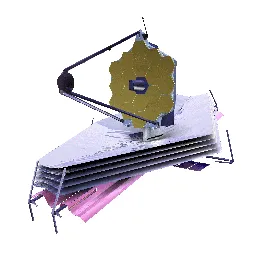
NASA has officially presented the mirror of the James Webb Space Telescope (JWST) at its headquarters in Washington. Seven times larger than the Hubble Space Telescope's mirror, this space engineering device developed at the Marshall Space Flight Center in Huntsville (United States) will allow scientists to observe the most remote places in the Universe and unravel how the first galaxies formed just after the Big Bang.
Via La Flecha
A telescope's sensitivity, something like its ability to detect details in observations, is directly associated with the size of the mirror area that collects light from the cosmos. A larger area collects more light to observe the farthest regions of space. The JWST, which will also have better resolution, is made up of 18 mirror segments that form a total area of 25 square meters when placed together.
The 18 mirror segments will be fully deployed once the telescope is in space, as its size prevents it from being fitted into a spacecraft. Engineers have solved this problem by giving the mirror a structure that allows its components to articulate like the leaves of a folding table, bending and fitting into the space of the rocket that carries it.
Each of these 18 mirrors can move individually, so they can be aligned together to function as one large single mirror. Scientists and engineers can fix any imperfections after the telescope opens in space or if changes occur in the mirror during the mission's lifetime.
Each segment is made of beryllium, one of the lightest known metals, which has already been used in other space telescopes and performs well in the very low temperature conditions of space. Each hexagonal-shaped mirror segment is 1.3 meters in diameter and weighs approximately 20 kilograms.
The primary mirror will be 2.5 times larger than Hubble's, which has a 2.4-meter diameter, but will weigh about half as much. According to researchers, the increased sensitivity compared to the Hubble telescope's mirror will allow scientists to observe when the first galaxies formed just after the Big Bang.
More information on this other NASA site