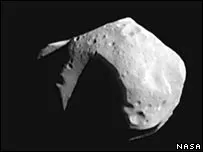
The United Nations (UN) is going to draft this year the outline of a treaty to determine what to do in case a giant asteroid were to impact Earth.
Via BBC
The document will determine global policies, including who should be in charge of plans to deflect an object.
It is an idea from the Association of Space Explorers, a professional body of astronauts and cosmonauts.
At this moment the United States Space Agency, NASA, carries out the tracking of 127 near-Earth objects that have some chance of impacting the planet.
The association has requested a group of scientists, lawyers, diplomats, and insurance experts to draft the recommendations.
The group will have its first meeting in Strasbourg, in northeastern France, in May of this year. It is expected that the final document will be presented to the UN in 2009.
"We believe a clarified decision-making process adopted by the United Nations is necessary," stated Dr. Russell Schweickart, one of the Apollo 9 astronauts, and founder of the Association of Space Explorers.
Known threat
The threat of an asteroid impacting Earth is being taken more and more seriously, as more near-Earth objects are being found.
In the U.S., Congress has tasked NASA with carrying out a more detailed search for asteroids that threaten life on Earth.
"Congress has said that the efforts of the United States Space Agency up to now have not been sufficient," says NASA's Dr. Steven Chesley.
"They have modified NASA's objectives so that the cataloging and tracking of asteroids forms part of its mandate."
Congress has asked NASA to carry out a much more aggressive investigation.
For the moment NASA tracks objects with a diameter greater than 700 meters.
To do this, the agency needs to use a new type of telescope.
Possible alternatives include creating a new system that is owned by NASA or investing in other telescopes that are already being developed, such as the Large Synoptic Survey Telescope or the Panoramic Survey Telescope and Rapid Response System.
The panoramic telescope is wide-field and is being developed at the University of Hawai'i, while the synoptic telescope is being developed by a non-profit corporation based in the U.S.
NASA estimates that there are about 20,000 dangerous asteroids that have not yet been discovered.
"Among those thousands of asteroids, there must undoubtedly be some that could impact Earth, with a high probability that the population will be affected," says Dr. Schweickart.
"It has gone from talking about an esoteric and statistical argument, to talking about real events," adds Dr. David Morrison, an astronomer at NASA's "Ames Research Centre."
Future plans
The draft of the United Nations treaty would establish who should be in charge in case an asteroid were headed for Earth, who would pay for aid plans, as well as the policies that should be adopted.
Furthermore, it will have to establish possible plans to deflect the object.
These plans can include impacting the asteroid with a spacecraft or with a missile.
Other less destructive proposals include using gravity as a "tow truck" to modify its trajectory.
But any decision to deflect a near-Earth object can bring its own questions, since changing the trajectory can alter its final target.
"It is important to understand that when an asteroid is deflected certain countries will have to accept an increase in risk for their inhabitants, in order to eliminate the risk for everyone," says Dr. Schweickart.
According to the Association of Space Explorers, complicated decisions like these can only be adopted by the United Nations.
It is no illusion to state that the process can be carried out quickly.
"One must act when things seem like they are going to happen because, if one waits until one is certain they are going to happen, it is too late," says Schweickart.
Among the experts who are going to draft the treaty are Lord Rees, head of the Royal Society of the United Kingdom, the former director of science of the European Space Agency, Roger Bonnet, and the former advisor to the British government, Crispin Tickell.
The proposals were presented at the annual meeting of the American Association for the Advancement of Science, held in San Francisco, on the west coast of the U.S.