A 27-kilometer circular underground tunnel, 1,000 powerful magnets and particles traveling through it at the speed of light: all this, part of a giant project on the border between France and Switzerland that will be the world's most powerful particle accelerator and will investigate the origin of the Universe.
Via BBC
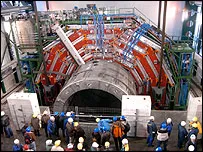
This week and after an operation that lasted 12 hours, a 2,000-ton piece of machinery was successfully lowered by a crane into a cavern 100 meters deep.
This machinery is part of the CMS, one of those four large detectors that will analyze the results of the collision and according to the builders, it is the most attractive and impressive part of the CMS, located at the European Laboratory for Particle Physics (CERN).
With a cost of about US$1,000 million, the Large Hadron Collider (LHC) will allow particles to circulate at such a speed that, when they collide head-on, they generate a phenomenon that could help reveal the secrets of the Universe.
Read: Recipe for making a Universe
At the four points where the particles collide there are huge machines that capture and measure the new particles produced by the impact.
This could explain new phenomena beyond the standard knowledge of today's physics, and a framework for explaining the interactions of subatomic particles.
The machinery that was lowered this Wednesday is known as YBO and forms the main barrel of the CMS. It is accompanied by two smaller barrels at its side.
The YBO, which will house the most delicate part of the CMS, is 16 meters high, 17 meters wide and 13 meters long.
"It is the largest of the 15 pieces of equipment we have to lower," said Jim Virdee, principal spokesperson for the CMS team's scientific team.
"Fifteen years ago, we were drawing this on a piece of paper. That's why seeing it assembled is very pleasant and also exciting," he added.
The specific objective of the CMS is to identify the elusive Higgs Boson particle, which is known as the "divine particle" due to its importance for physics.
Read: Did they see the divine particle?
According to scientists, the Higgs Boson is the essence of matter and explains why all other particles have mass.
The LHC is expected to be completed by the end of this year.
More information at CERN