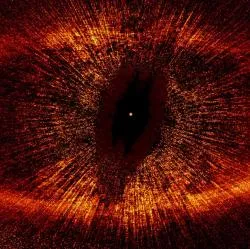
John Jhonson of the University of California at Berkeley and his colleagues presented the discoveries at the American Astronomical Society (AAS) Meeting in Honolulu.
Via Jeanna Bryner, Space.com
This is the discovery of another 28 planets outside the solar system, which increases the list to 236 exoplanets, revealing that planets can exist around a variety of stellar spectra, from small and faint stars to giants.
"We have added 12 percent to the total in the last year, and we are very proud of that," said team member Jason Wright.
The planets are among 37 new objects discovered in the last year. Seven of which are failed stars, called brown dwarfs.
One of the exoplanets was discovered two years ago, but recent observations allowed measuring its mass, radius and density. The ice giant orbits the star Gliese 436 (GJ 436) and has a radius and density surprisingly similar to Neptune and possesses 22.4 Earth masses.
"Gliese 436b must be half rock and half water with, perhaps, small amounts of hydrogen and helium," commented team leader Geoffrey Marcy. "Therefore this planet has an interior structure of a super-Earth/Neptune hybrid, with a rocky core surrounded by a significant amount of water compressed into solid form by high pressures and temperatures"
It orbits its star every 2.6 days, which makes it very close to it and has an eccentric orbit, which could indicate that the star might have another more distant planetary companion.
GJ 436 is an M-type star and since a large majority of stars are of this type, it is very important the discovery that such a star can support planets.
Bigger is better
At least four of the newly discovered planets belong to multiple systems, supporting the idea that at least 30 % of stars with planets have more than one companion planet.
And three of the recently discovered planets orbit stars whose masses are between 1.6 and 1.9 times that of the Sun. The stars are of type A and F, which are difficult to detect because they rotate very fast.
Johnson discovered that type A stars, which have burned almost all of their hydrogen and remain stable for a while, have slower rotations and are not as hot. This makes planet detection easier, since the search is usually based on planets generating a "wobble" in the stellar orbits that allows them to be discovered.
Unlike planets orbiting M-type stars, these exoplanets usually orbit at least 0.8 astronomical units, 0.8 AU (1 AU is equal to the Earth-Sun distance, about 150 million km) from their host star.
For this reason, massive stars are more likely to be hosts to Jupiter-sized planets than lower-mass stars, commented Johnson. And aged A stars have twice the chance of stars like our Sun, which the astronomer attributes to the fact that larger stars begin with more material in their disks that allows planetary formation.
Related links
- AAS 210th Meeting
- Wikipedia: Stellar evolution
- Wikipedia: Star classification