A well-known English magazine of astronomical outreach published last April the results of a very concise work done by three researchers from the Faculty of Astronomical and Geophysical Sciences of the National University of La Plata. The topic focuses on some extremely distant and intensely energetic objects that are not easy to observe.
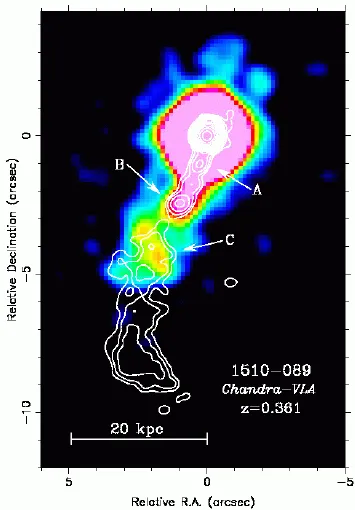
Image of Blazar PKS 1510. Credit: C. O'Dea
By Alejandra Sofía
Bulletin 212 (News from the La Plata Observatory)
When this is achieved, behaviors worthy of explanation appear, to the enthusiasm and sleeplessness of those interested. And that is where there was no agreement among colleagues from other parts of the world; more than that: there were strong disagreements that challenged any physical explanation. The Argentines found an explanation, and this is what Dr. Sergio Cellone tells in this article.
Images at:
http://www.fcaglp.unlp.edu.ar/~extension/212/blazars/
Before the dialogue, the introductions:
Dr. Sergio Cellone, professor and researcher at the Faculty of Astronomical and Geophysical Sciences (FCAGLP) of the UNLP and CONICET. Dr. Gustavo Romero, professor and researcher at the FCAGLP and the Argentine Institute of Radio Astronomy (IAR, CONICET). Lic. in astronomy, Anabella Araudo did her undergraduate thesis under the direction of both. They are part of a broader research group: the Group of Relativistic Astrophysics and Radio Astronomy (GARRA) of the IAR and the aforementioned Faculty.
It is not so simple, even for astronomers themselves, to study such distant objects, where the main difficulty is, precisely, being able to distinguish them. Under the term Active Galactic Nuclei coexist quasars, Seyfert galaxies, radio galaxies and blazars.
Blazars - the topic that generated a controversy - are the most variable objects in this group of AGNs and have the most extreme properties. A blazar emits jets of matter at speeds almost close to that of light. Those jets are what the specialists manage to see.
-How did you get a space in the English magazine "Astronomy Now"?
The work in question was approved last August and published in January of this year in "Monthly Notices of The Royal Astronomical Society". The journal's referee - a figure in scientific publications who approves, suggests modifications, or rejects the submitted work - answered us in just two weeks and in 28 very complimentary lines gave his approval. He only marked some minor corrections.
The journalist from the outreach magazine "Astronomy Now" surely has contact with that publication and took up the topic. Then he wrote to me to give some details about the group, the motivations for the work, whether it is part of a larger project.
-Tell us a bit more about the work that, as we already mentioned, deals with a controversy regarding the brightness variations of some blazars.
Measuring those variations on timescales of a few days, and even hours, is a powerful tool for studying the innermost regions of active galactic nuclei (AGNs).
The undergraduate thesis work of Anabella Araudo was a topic that addressed a controversy. In general, those of us who work on the topic agree that the variability of blazars is, at most, 10% in one hour; we also find variations of 100% in 24 hours as something striking.
But there are a couple of groups of researchers who said they found variations of 50% in 10 minutes! If that were the case, there is no physical way to explain it. Our impression was that the work was questionable from a technical point of view. The serious thing was that about a dozen similar works were published, with the consequent confusion this could cause, if they were erroneous results.
Araudo's thesis aimed at a statistical analysis based on known techniques: what we did was apply that very rigorous statistics to the data we had and the data these other people had. It turned out that they had done a poor treatment of the errors inherent to the measurement.
We are not discovering anything brilliant or amazingly new, simply our work is very concise and hit the topic right on target. Now no one will be able to say that a blazar varies its brightness by 50% in ten minutes without showing a rigorous analysis of their data and techniques.
The "exaggerated" variations of these blazars recorded optically come from incorrect photometric techniques and not from physical factors of these objects.
-What happens with those who published contrary to your findings regarding brightness variations in blazars? Is there, was there contact?
One of them wrote to us, he was not the principal investigator of the group. And he again argued, with different arguments, the same result.
-Where did you observe, for how long?
Anabella made observations at the El Leoncito Astronomical Complex (CASLEO) where the UNLP's 2.15 m telescope is located. She observed some blazars during two runs of about five days each, at different times of the year. On one occasion she observed with me and on another she did it with Lic. Anahí Granada.
She took a sample of three of the objects for which very extreme brightness variations had been reported. She recorded variations, but of half a magnitude in 24 hours, that is, 50%. And only variations of 10% in a matter of hours. We applied all the statistical criteria and error analyses showing that the observed variations were real. And we also "simulated" results using an inappropriate technique, showing that in that way the very extreme variations arose.
-Statistical criteria...
If you are observing a blazar, for example, and a cloud passes by, the measurement result varied, but obviously not due to a physical cause intrinsic to the object in question. So these measurements are made by differences: the blazar is compared with a star observed at the same instant, in the same field of the image. Since both objects are affected by the same problems (clouds, or whatever), any variation not intrinsic to the object cancels out.
The selected star has to meet certain requirements; if it is much brighter than the object you want to measure, the errors behave differently and this can lead to the extraordinary, but incorrect, results that other colleagues have shown. There are works from several years ago that show a series of statistical analyses on the errors that arise in photometry.
If you apply them correctly, you get the significance of the variation, that is, how reliable or not the result is. It can be a highly or poorly significant variation. What for some of our colleagues was a highly significant variation, when we made all the corrections for brightness difference, etc., gave us that the selected object and the reference star varied in the same way. That is, the very extreme variations were due to errors introduced by the instrument and the atmosphere, and not due to physical processes in the studied blazars.
-So the problem is not the object you see but the reference you use.
Exactly. You must use a suitable reference star; if it is too bright, you lose all the sensitivity and reliability of the method.
-How much does the instrument used for these variation records matter, if it is different from what other people use?
CCD cameras are used and each one has particular characteristics; that's why you enter all the parameters into the formulas you use, to estimate how significant the variation is. This includes the technical data of the detector, the sky brightness level, etc. With all this, you can find out if the variation is real or not.
However, the factor that weighs the most is the brightness of the stars used for comparison: in the works that reported very extreme variations, some were 100 times brighter than the object they wanted to measure!
-Is that due to a naive error or is there another explanation?
It's a difficult answer, the issue is complex because there are different matters, there are peer reviews that are somewhat weak in their evaluations and it results in somewhat careless works having an endorsement and appearing published in weighty journals in the specialty.
More information about AGNs at:
https://www.fcaglp.unlp.edu.ar/pipermail/listadenoticias/2007-March/000226.html