In a special edition of Astronomy & Astrophysics to be presented next week for free, the first set of results from a long project conducted with the XMM-Newton observatory, a study of the Taurus molecular cloud, will be presented. Started in 2003, the program is formed by an international team of 30 astronomers led by Manuel Güdel.
Via EurekAlert
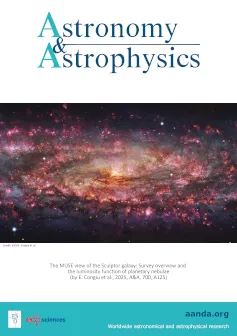
Cover of Astronomy & Astrophysics with an image of the Taurus region. M. Güdel, et al.
The large molecular gas cloud in the constellation Taurus is the closest star-forming region, an environment for testing the theories of experts in the field. The XMM-Newton project provides the most complete and sensitive study of this region, for the first time systematically detecting almost all the young stars hidden in the cloud as X-ray sources, including brown dwarfs and protostars. X-rays are thought to be emitted by very hot gas that gathers due to magnetic fields just above the stellar surface, as in the case of the solar corona but with much greater intensity.
The sensitive spectroscopy provides clear information confirming that those stars in which gas currents continue to fall from the surroundings emit fewer X-rays than those in which this accretion process has ceased. Analyzing the high-resolution spectrum of the accretion gas of young stars, the team proved the presence of an unusual amount of cold gas (1-2 million degrees) in the stellar atmosphere in addition to the hot plasma of the corona (10 million degrees). The cold accretion currents originate in the gas disks orbiting the star. As the gas falls toward the star, it appears to penetrate the hot regions of the corona and cools it as it mixes with the hot gas. As the hot gas cooled, the remnant produces fewer X-rays. This so-called "soft excess" of cold gas is not seen in any star without accretion, therefore, the latter emit more X-rays than those that continue to accrete.
After their observations of strongly accreting T Tauri stars, the team noticed a new process, which they also confirmed using Chandra observations of the same stars. In these stars, the X-rays are so strongly absorbed by the falling gas that the team expected the stars to become almost invisible in the optical range, since small dust particles are usually hidden in the gas currents, which would absorb the visible light from the central star. Surprisingly, the star is still brightly visible, which means the dust particles are not there. Manuel Güdel and his colleagues suggest that the star's light was strong enough to heat and destroy the dust at a certain distance from the star.
Finally, the team found that stars with strong accretion also emit an additional but very soft and unabsorbed component of X-rays. They are not rays formed in the corona by the gas currents because they would also be absorbed. Instead, the component must come from somewhere outside the corona where absorption is low. The team suggests that these soft rays come from the jets expelled by the central star. The hypothesis is confirmed by Chandra observations of one of the stars. This discovery was completely unexpected because there was no evidence of hot gas in this jet. The process that heats the gas jet to millions of degrees is not clear. Shock waves in the jet could be responsible, but their speeds are too low to release the necessary energy. Alternatively, it is thought that spiral magnetic fields could be responsible.
Related links
- Special edition of Astronomy & Astrophysics and ESA:
Special feature on the XMM-Newton extended survey of the Taurus molecular cloud
(Published in Astronomy & Astrophysics, volume 468-2, June III 2007) - Table of contents
- Research team site
- Star Formation and Protostars