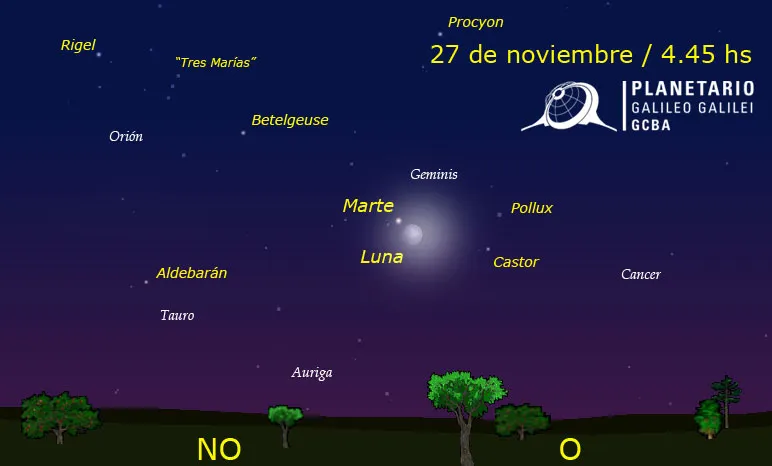
For today, the sky promises to be full of "stars." Venus will be 4° East of the Moon (5.00 h) and Regulus, Pollux, and Castor can be observed.
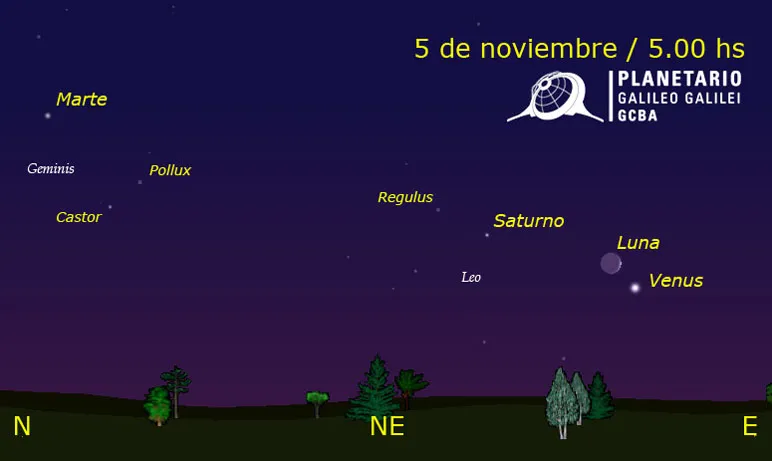
Venus is the extravagantly luminous "star" low in the eastern sky. You can't miss it—especially because the waning Moon will be nearby. The pair, whose members are located very close to each other, is one of the most charming spectacles that can be seen in the sky.
If you can, turn your gaze away from Venus and the Moon. Just above them is Saturn, a delicate yellow beauty that clamors for the telescope's attention; even the smallest of these instruments reveal Saturn's stunning rings. And above Saturn, almost directly overhead, shines Mars. This planet is bright, truly orange, and, for reasons science cannot fully explain, a bit hypnotic.
You won't be the only one looking at the planets. Orion, the Hunter, is there too, outlined in the sky like an hourglass formed by first and second magnitude stars. Joining Orion are Castor, Pollux, Regulus, Aldebaran and the brightest of all, Sirius, the Dog Star, bluish-white in color: star map. This stellar display frames the planets in a scene that will surely be fascinating—until something arrives to break the spell.
That something would be the spacecraft: The space shuttle Discovery and the International Space Station (ISS).
The two orbiters are scheduled to fly over many towns and cities in the United States on Monday morning. If things go according to plan, the Discovery spacecraft will undock from the ISS at 5:32 am EST (updates), meaning the two craft will appear as bright points of light, well differentiated, one next to the other, sliding together as they pass near Mars, Sirius, Orion, Venus, and the Moon.
Sources and related links
- Note at Ciencia@NASA
- Sur Astronómico
- Galileo Galilei Planetarium