While doubts exist about the feasibility of returning to the Moon or trying to go directly to Mars, another option emerges for our next steps in space: the Lagrange points.
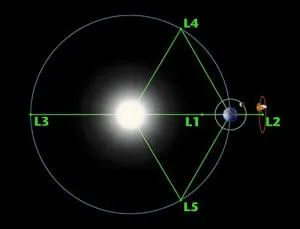
A White House commission, led by Norman Augustine, is reviewing NASA's plans for human spaceflight and is considering, according to New Scientist, sending astronauts to those places in empty space. The Lagrange Points are special because there the gravitational acceleration of the Earth and the Sun are equivalent, allowing objects to remain there with little effort.
Being far from hot stars and planets, they are useful for telescopes that measure the fluctuations of deep space. The WMAP probe, which measures the radiation from the big bang, is located at the so-called Lagrange point L2, more than a million kilometers from Earth. Hubble's successor, the James Webb telescope, will be sent there too.
"If you look at the list of future space telescopes, they all go to L2," said Dan Lester of the University of Texas, who spoke with the review commission in July. "It's going to be a very busy place out there."
But what could humans do in that place? A useful task is repairing and modernizing the new telescopes, as astronauts have already done with Hubble on five occasions.
The Hubble Space Telescope is one of the most productive scientific facilities in the history of science mainly because every four or five years its instruments are updated and repaired. "If we want humans to have something to do with the new instruments, we have to think about the Lagrange points," Lester noted.
The solar system's superhighway
Astronauts wouldn't have to go as far as L2 to be useful. Lagrange points exist in the Earth-Moon system, as well as in the other planets of the solar system.
Traveling between two of these points requires very little energy. Massive objects like the Sun and planets have gravitational fields that resemble mountains and hills, but Lagrange points are like gravitational plains. Once on the right path, a spacecraft can travel through the gravitational contour of space between these plains, as if traveling on an interplanetary superhighway.
Future astronauts could repair telescopes in an area at the nearest Lagrange point of the Earth-Moon system and then send them back to L2 when the repair is finished. They could even assemble telescopes and spacecraft in that place to later send them to their destination.
Small steps
Others see Lagrange points as stepping stones on the way to places like Mars.
"The place we all want to go is Mars," commented Lou Friedman, founder and executive director of The Planetary Society. But he also noted that Lagrange points present "the closest milestone to Earth that is beyond the Moon."
Traveling to L2 would take about a month and communications from Earth would take four seconds to reach L2. In contrast, reaching Mars would take at least six months and communications would have a 20-minute delay.
NASA could use a Lagrange mission to test technologies needed to reach Mars—such as life support systems and ways to protect astronauts from radiation—while having easy contact with Earth.
It would be a stepping stone, higher than a trip to the Moon and lower than one to Mars, in the same way that the Gemini program didn't go anywhere (except to low Earth orbit) but everyone understood that each step was necessary to reach the Moon. "With each step we improve our ability to go further," summarized Friedman.
The commission on the web

The U.S. Human Spaceflight Review Commission has its own space on the web. There they upload videos, transcripts and presentations from the meetings they have been having during June-August.
At the July 28 meeting in Houston, Texas, Lagrange points were mentioned as an alternative for analysis.
On the site you can access the videos (on Vimeo) of that meeting:
HSF Committee-Public Meeting-Houston Astronaut Office Perspective-Steve Lindsey and a transcript of the video.
In the transcript of the video from the July 28 meeting, Steve Lindsey, representing the Astronaut Office, noted (Lindsey: 12:29:52):
"(...) There are many ideas out there, about whether to go to the Moon or to an asteroid or to a Lagrange point. We think the architecture should be capable of supporting all those types of places..."
On July 30, 2009 they also met in Cocoa Beach.
There, Edward F. Crawley, professor of aeronautics and astronautics, spoke extensively about Lagrange points.
You can access the transcript of the video of the meeting and videos of it, as well as the presentations (PPT):
HSF Committee-Public Meeting-Cocoa Beach,
FL-03b-Sub-Group Exploration Beyond LEO
Edward F. Crawley:
(...) And we also have these special points, the experts call them Lagrange points. I like to think of them as locations on the frontier of Earth's influence as a body. When you go past the Lagrange points, you've passed into real space. You've passed most of Earth's influence. And all of them represent possible places, exploration destinations(...)
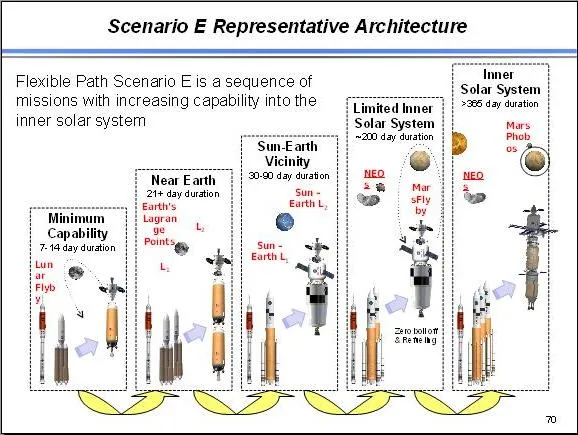
Whether this proposal materializes or not will depend on many factors. But the proposal is flexible and comprehensive. It is not a mission with the sole objective of putting astronauts at L2. On the contrary, the approach proposed to the commission is that space exploration cannot start and end on the Moon. It must be thought of in terms of team, technology and higher objectives, with a long-term vision. Mars and Venus seem to be those great goals, which to be achieved can be very useful intermediate steps.
But costs, timelines and the "hook" with the public are also evaluated. In this sense, it may seem unlikely that people will get excited about sending astronauts into empty space. However, the possibility of reaching the space telescopes that will be installed there to repair and improve them is a magnificent option.
For now, the question in the title has no answer. But they are thinking about it.
Sources and related links
- New Scientist: Why future astronauts may be sent to 'gravity holes', by Lisa Grossman
- Review of U.S. Human Space Flight Plans Committee
About the images
- Illustration of the Earth-Sun Lagrange Points
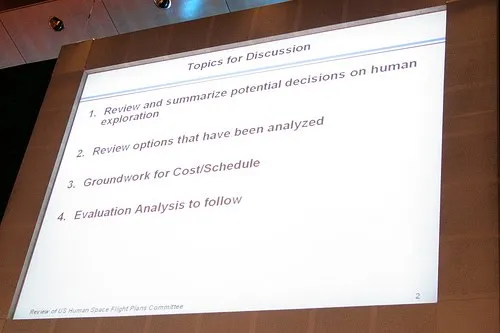
Credit: NASA - Image from the Flickr profile of the U.S. Human Space Flight Plans Review Committee, from the public meeting in Washington, 08-12-2009.
Credit: NASA/Dennis Bonilla
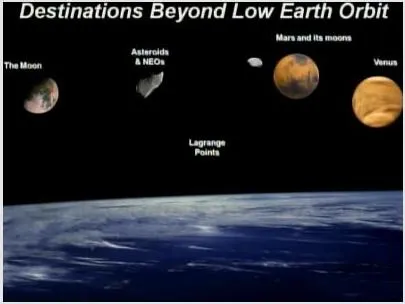
http://www.flickr.com/photos/nasa_hsf/ - Destinations beyond low Earth orbit and image Flexible Paths
From the Presentation: "Why We Explore, Where We Should Explore, and How?"
Beyond Low Earth Orbit, Sub-Committee Report
Credit: Wanda Austin, Bo Behmuk, Chris Chyba, Jeff Greason,Ed Crawley, chair - Logo of the committee
Credit: NASA