A researcher and a group conducted a study on the clouds on Titan, Saturn's moon. The group published first, despite the "lone" researcher warning them of errors. Then he published second, criticizing the first paper. And all hell broke loose. The backstage of scientific research allows us to see that, after all, scientists are human beings.

I am reading, by chance, the book "The Scientist Is Also a Human Being", by sociologist Pablo Kreimer. I hope to comment on it soon because it is surprising and necessary.
And I come across this story that allows us to glimpse that, despite quantifying, measuring, and analyzing, the scientist ultimately "interprets." And he does so permanently, throughout the entire course of his research, not just at the end. And there is subjectivity there.
The case is as follows:
Mike Brown is an astronomer at Caltech. And he has a blog "Mike Brown's Planets" where he tells what I am going to translate below. I warn that, given the length of the text, it will not be a complete translation of his post "The Problem with Science." There he tells us that he has been having a discussion with a group of scientists about the presumed errors in a paper.
"Both articles are catalogs about where the Cassini spacecraft sees clouds and where it does not see them on Titan, in the last 4 years. Papers like these, although they will not be newspaper headlines, are important contributions to understanding what happens on that moon. Without complete and precise catalogs of things like the location of clouds on Titan we cannot begin to understand the deeper questions of why there are clouds and what that tells us about the hydrological cycle of the natural satellite. These studies do not attempt to answer all these questions, but they are necessary tools in the puzzle," Brown explains to us.
"You might think that two papers examining the same collection of Cassini images to map the clouds on Titan will result in the same answers, but no. And there lies the root of the problem. When the main topic is about where there are clouds on Titan and then you say there are clouds where there are none and vice versa, you have a problem. They have a problem, because theirs is the one that contains errors," Brown points out.
How the story was cooked up
"I started writing my paper 18 months ago. A few months later I realized another team was writing the same article. Instead of writing two identical articles, I joined the team and we merged the study. The problem is that, while I worked with the team during the summer, it became clear that their analysis was not reliable. I spent hours going to the images showing them the places where there were and were not clouds, in contradiction with their analysis. Finally I reached the conclusion that their method of finding clouds, and therefore, their article, was unsalvageable. I politely withdrew my name from their paper and explained my reasons in detail to the senior members of the team who were leading the article. Then I invited them to join my analysis in a demonstrably more accurate way. The lead member of the team agreed that it seemed unlikely their method would work and said they would discuss and then call me," continues the Caltech astronomer on his blog. Then he comments that he felt good about having overcome a potentially bad situation in a good way and that, as a result, he felt he had come out with good science and good colleagues intact. And that since scientists are not usually so good at these things, he felt even better.
Then he continues telling the other part of this "novel." He did not hear back from the team, so when he wanted to present the results of his analysis at a conference in December, he contacted the team and asked them if they wanted to join as co-authors on his presentation, and thus prepare for writing the article. And they told him no, that they had decided to do the paper on their own. There Brown realized that things perhaps had not been as nice as they initially seemed.
In June, the team's paper came to light, before Brown's, in the prestigious Nature. There Brown adds that it is not hard to understand why one often hears in the hallways the malicious comment 'Just because it's in Nature doesn't necessarily mean it's wrong.' To translate, the prestige that publication has among non-scientists is not the same as it seems to have among them, at least among some researchers who think that impact is sought more there.
Brown continues telling that his paper only came out this week, but since the other one was already published, one of the referees asked him to compare and comment on that other article. Let's stop here and think, without being researchers ourselves, but putting ourselves in their place, what we would do.
The one from Caltech says that until that moment he had avoided reading the other paper. Partly to not condition his own article and partly because it upset him that they had published even though they knew it contained errors. But he hoped that, somehow, they had corrected their flaws. And that, upon finally reading it, he thought that had not happened.
And what did he do? According to him, he wrote one of the most direct statements we will ever read about someone's paper containing errors. Although things like that are usually softened with language, feeling that they had published something they knew was wrong, he thought he should be more direct. And that, of course, now, the other team is furious.
Then Brown makes a series of assumptions about what the other team must think of him: that he is angry only because the other article came out first and in a more prestigious journal; that what matters are the conclusions, not the details; that he is a traitor; and that he is an "impolitic ass" (uhh...let's say a "tactless idiot") and that they hate him. Of course, he thinks the first and third are false; that the second is bad science (the details do matter) and that he is guilty of the last.
The other team blames him for being disproportionately harsh with them. Brown says he was proportional to their mistakes. So his colleagues will always think that he crossed the line by coming down so hard on them, and he will think that it was the others who crossed a limit by publishing a paper they knew contained fatal errors.
And who is right? Well, that's the bad news. We don't know. What is clear is that this is a demonstration of the egos and emotions that also play a role in science. And, Brown thinks, rightly, that the only ones who lose are themselves. Reality goes on. And as he tells on his blog, the Titan study was a hobby for him, one he cared about, but it will be no more. It will be time to start exploring again, he says finally.
In the comments they ask him what the difficulty of performing the analysis was. Brown replies that the other team's mistake was trying a computerized, automated method without checking; while his group went like a fool to each image. But that being a "fool" is often better.
More interesting is, perhaps, another comment in which they suggest to Brown that he give a suggestion of conduct for someone who has not yet reached his career position. For a new PhD, a discussion like this could be costly. And that is precisely what Brown answered: "Don't do it." And later, following another comment, he suggests "choosing our battles carefully."
While reading this story, a fantastic song by an old group of extraordinary guitarists, GTR, with one of their most successful songs, was playing in my head:
"When the Heart Rules the Mind"...
The papers in discussion
Brown avoided mentioning who makes up his team and the other one or which articles they were. However, in a later note he indicated that they are:
Global circulation as the main source of cloud activity on Titan
Sébastien Rodriguez et al.
Nature 459, 678-682 (June 4, 2009)
DOI:10.1038/nature08014;
Received 28 November 2008; Accepted 23 March 2009 arXiv:0907.0606v1
At the end of the paper, in the acknowledgments, it says:
"We thank M.E. Brown for fruitful discussions that allowed us to greatly improve the quality of this study"
As for Brown's:
Clouds on Titan during the Cassini prime mission: a complete analysis of the VIMS data
Brown, M.E., Roberts, J.E., Schaller, E.L.
Icarus, in press.
DOI:10.1016/j.icarus.2009.08.024
Accepted 7 August 2009.
Paper on Brown's site
Sources and related links
About the images
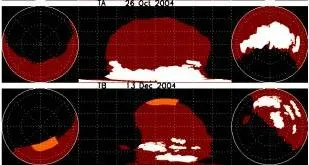
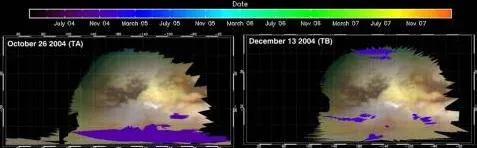
- Images belonging to each paper: The first corresponds to Brown's and the second to Rodríguez's. Both are Cassini flyby images from the same date in 2004. Credits: S. Rodríguez et al; M.Brow et al.
- Composition of a drawing by AKCx and an image of Titan, from NASA