A documentary about the life of the last Argentine Nobel Prize winner: César Milstein, premieres on March 11. His grandniece, Ana Fraile, connected the scientist's words and actions, in a project that was 40% funded by the Ministry of Science, Technology and Productive Innovation.
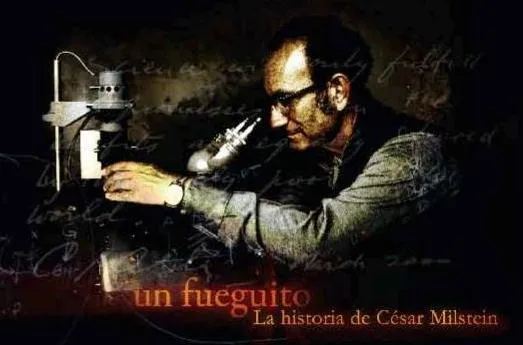
"Science has the fascination of adventure because, above all, it is an exploration into the unknown," said César Milstein once, the last Argentine Nobel Prize winner who, with his adventurous style, invited us to think of a new conception of the scientist figure, far from the routine of the laboratory and more akin to the adrenaline and creativity that all research entails.
With the goal of keeping this proposal alive over time, Milstein's grandniece, Ana Fraile, gave shape to a project that had been brewing in her mind for a long time: a film.
Thus was born "Un Fueguito" (A Little Fire), the documentary that narrates the life of her great-uncle and which will premiere on March 11.
Fraile worked together with Lucas Scavino –editor and screenwriter of the film– to intertwine the anecdotes, interviews, images and memories that helped recreate Milstein's story and share it.
Indeed, one of the main objectives of the proposal –they explain– is to spread the adventurous spirit of the Nobel laureate and demonstrate to what extent science rubs shoulders with art, adventure and life itself.
The idea of making a film "about science and art; about the importance of research and creativity" –in Fraile's words– was conceived, initially, between Milstein and his grandniece.
However, due to several factors –among them the 2001 crisis and the death of the scientist in March 2002– the project stalled.
Fortunately, the work received logistical and financial support from different institutions and could be disseminated thanks to the help of Celia, Milstein's wife.
Indeed, before its premiere in Argentina, the documentary was shown in the auditoriums of the universities of Cambridge and Oxford and also at Wellcome Trust, in London.
Subsequently, the work –declared of National Interest by the Secretariat of the Presidency of the Argentine Nation– was 40% funded by the Ministry of Science, Technology and Productive Innovation, headed by Lino Barañao.
Also collaborating were the Foundation for Technological Development (FUDETEC), the National Institute of Cinema and Audiovisual Arts, the Fundación Instituto Leloir, the YPF Foundation, Celia Milstein and professors Herman Waldmann and Gregory Winter.
Video: Interview with the producers of "Un Fueguito" and trailer
On the web
The documentary Un fueguito has its own website with additional material and information: http://historiamilstein.com
About César Milstein
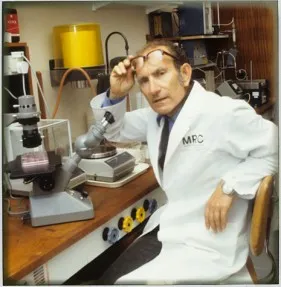
Milstein was born in the city of Bahía Blanca, province of Buenos Aires, in 1927.
At 25, he graduated as a chemist from the Faculty of Exact Sciences of the University of Buenos Aires (UBA) and five years later he was appointed by competition at the Instituto Nacional de Microbiología Carlos Malbrán.
Later he was awarded a scholarship by the British Council to work in the laboratory directed by Frederick Sanger –also a Nobel Prize winner–, the Medical Center Research, in Cambridge and later returned to the country to be director of the molecular biology department of the Malbrán Institute.
In 1961, back in Europe, he carried out important research that revolutionized the field of biotechnology. About 22 years later, Milstein was appointed head and director of the division of Protein and Nucleic Acid Chemistry at the medical research council's laboratory of molecular biology in England.
One year later, in 1984, he received the Nobel Prize in the category of Medicine and Pharmacology for his theories related to "specificity in the development and control of the immune system," and the discovery of the technique for producing monoclonal antibodies on a large scale.
Even though it would have made him enormously rich, Milstein did not register any patent for his award-winning discovery, because he thought it was intellectual property of humanity and as such he bequeathed it. According to his convictions, his work lacked economic interest and only possessed scientific interest.
Even though it would have made him enormously rich, Milstein did not register any patent for his award-winning discovery, because he thought it was intellectual property of humanity and as such he bequeathed it. According to his convictions, his work lacked economic interest and only possessed scientific interest.
On March 24, 2002, he died due to a heart condition.
Sources and related links
- historiamilstein.com/
- The material is courtesy of Prensa Argentina/Secretaría de Medios.
About the images
- The images belong to the site historiamilstein.com/from Ana Fraile.
- The interview was conducted by Sala de Prensa/Prensa Argentina.