It is an exhibition by the Max Planck Society and the Argentine Ministry of Science that invites you to discover the mysteries of the universe, from the smallest to the macrocosm. I was there and here I tell you what the exhibition is like.
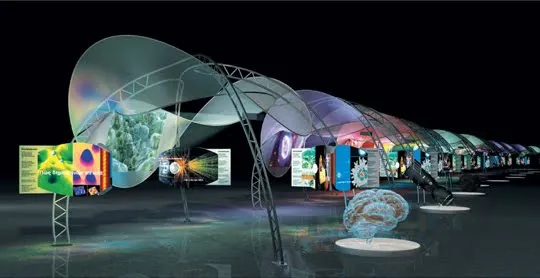
The exhibition allows us to go through 12 stations, through which the knowledge that humanity possesses on various topics will be narrated, as well as the questions that are still trying to be answered.
The narrative is visual, through static and interactive screens that point out the important points of each of these stations. Some people act as guides to better explain each thing and there is also the possibility of accessing audio guides, as I will tell below.
The topics covered are some of the most exciting in science: from the nanocosmos, the human organism, the mind and the senses, computer technology, sustainable development, climate change, life on other planets and black holes.
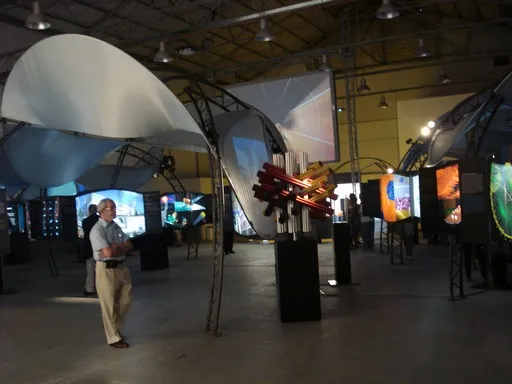
Upon entering the building, the tour goes from left to right. Each station has several screens, some of which allow some interaction. For example, there are screens that have a control with a scroll to move the mouse that will appear on the screen in front and a button to select. These screens allow you to choose among some topics within which we can watch a video about it.
There are other types of interactions with the viewer: screens through which "3D" images are viewed that can be rotated without touching the screen, either by the movement of fingers in front of it (without touching it) or by the tracking of a video camera that recognizes the movement of the viewer and rotates the diagram to be shown according to that direction.
There is also a station, shaped like a telescope, through which it is possible to view three-dimensional images of Mars, thanks to the fact that it has two eyepieces, one red and one blue, like the lenses for anaglyphs.
Models are exhibited, such as one of the rovers on the red planet, as well as others related to space exploration, but also on many other topics like those mentioned above.
It is certainly not a playroom for kids. The children look at and touch everything, ask incredible questions that parents try to answer as best they can and, in some cases, the answers I heard seemed wonderful to me. But it is not a place to play, although it is to be amazed and learn, to see things we may have never seen before and to know what is being researched. That is why, although I saw many young children, I think those over 12 years old will get more out of it.
There are some stands in the center of the exhibition, like the one from the Ministry of Education, and from German universities and companies (Basf, Siemens).
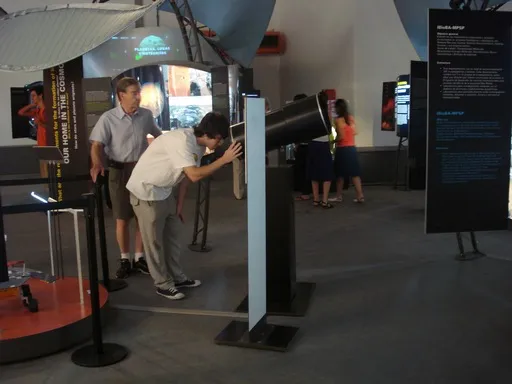
The tour can be done in approximately one hour, but if you want to see everything and use the screens, it is possible that, depending on the number of people, we may have to do more than one round. In some cases, like the device for viewing images of Mars (image on the left), I suggest "getting in line." If we wait for that station to become "free" we could spend all day going around.
I also recommend losing your shyness. I'm a bit old for some things now, but later I reproach myself for not having done this or that. In particular, for those who dare, I recommend Einstein's bicycle.
There is no problem with spectators taking pictures and videos, but it is somewhat annoying to take many pictures with flash, although since the area is full of screens, logically it is a somewhat dark environment, not to hinder the walk, but to take pictures without flash.
That said, I have a small album on Flickr with photos of the exhibition and I accompany the note with a video made to give a slightly better account of the interactive screens.
Video: The Tunnel of Science in Buenos Aires
http://www.youtube.com/watch?v=R357WCv1Sok
According to information at the site, the exhibition ends on April 20 and will unfortunately depart for Mexico. I don't say this for my Mexican friends, but because I hoped the exhibition could be seen in some other cities in the country before leaving.
On the Tunnel of Science website that the Ministry of Science has, there is, however, an interactive tour of the exhibition in Germany. I must say that what I saw here in Buenos Aires does not vary much from that exhibition.
On April 8 the exhibition will remain closed to the public. According to information, the President of the Nation will visit that day. It seems logical to me that the exhibition is not opened before the presidential visit, but they could have organized it in the morning so that the exhibition could be toured in the afternoon, for example. I say this because until April 20 there is little time, hence I recommend to residents and visitors of the City of Buenos Aires not to postpone their visit to the exhibition, if they are interested. It is also open on Saturdays and Sundays.
In short, it is a beautiful exhibition of the knowledge and questions that humanity possesses related to various scientific and technological disciplines. More recommended for kids in high school. Schools can request a guided tour through the official page. And it is also suitable for those of us attracted to science, whatever our age. It is not necessary to have specific or advanced knowledge, but rather the desire to immerse ourselves in the tunnel of knowledge that perhaps does not generate the same adrenaline as a roller coaster, but is intellectually more exciting.
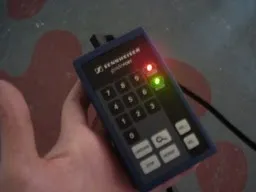
About the audio guides:
The guides consist of a small device with an earphone through which what we see at each station is narrated. The narration can be accessed in different languages and you can select which station to listen to and repeat each one. These guides are not given to all visitors. Upon entering, as I said, the tour begins to the left. To the right there is an information desk. There we can request the audio guide, in exchange for handing over our ID or identity card.
It gives the impression that the exhibition has a large number of devices, but to be honest, I think they can end up being annoying and add nothing to what is written on each sign or screen. Particularly if you go with children or if you intend to take pictures, the device can be annoying.
Sources and related links
About the images
- Credit: Ministry of Science, Technology and Productive Innovation and the Max Planck Society of Germany