Within the framework of the International Astronomical Union Symposium No. 275 at the Planetarium, two extremely interesting lectures with top-level professionals will be presented.
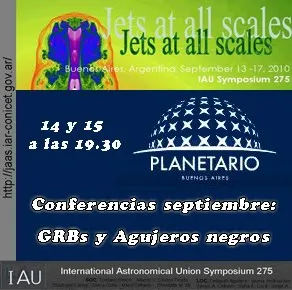
Just as the Galileo Galilei Planetarium of the City of Buenos Aires allows us to enjoy its shows, it also carries out many other activities, such as free courses, observations with telescopes, talks and lectures with distinguished professionals, like the ones we will be able to enjoy on September 14 and 15.
They will be lectures within the framework of the Symposium Jets at all scales, which will take place in Buenos Aires between the 13th and the 17th of this month.
Tuesday, September 14, 19:30 h
GRBs, the most energetic phenomena in the Universe, and their study with robotic instrumentation
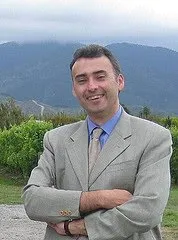
Dr. Alberto Castro Tirado (Institute of Astrophysics of Andalusia, Spain)
The first view of the stars through a telescope with our human eye is one of the memories that will last our entire life. But the view through the computer in broad daylight of the images captured by our other "electronic" eye on the other side of the Earth is also one. The network of robotic telescopes BOOTES (Burst Observer and Optical Transient Exploring System) that is being installed on our planet is allowing us to do first-rate science. Particularly in the field of gamma-ray bursts, the most energetic cataclysmic phenomena in the Universe, which in many cases represent the cry of a newborn black hole in the Cosmos.
Dr. Castro-Tirado was born in Málaga on October 28, 1966. He graduated in Fundamental Physics from the University of Granada in 1989 and earned a doctorate in Physical Sciences from the University of Copenhagen (Denmark) in 1994.
He is currently a first-rate figure in the field of robotic Astronomy.
(Free activity)
Wednesday, September 15, 19:30 h.
Black holes and the dawn of the Universe
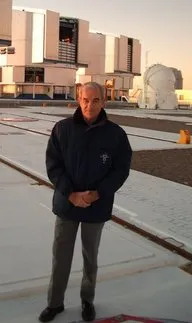
Dr. I. Félix Mirabel
(Institute of Astronomy and Space Physics, Argentina)
Black holes are the most enigmatic objects discovered by modern astrophysics. Their gravitational attraction is so intense that, like holes in space, they suck in matter that approaches them and do not let light escape, remaining forever dark. For over two centuries their existence was a matter of mere speculation, but for the past two decades compelling evidence has accumulated about the existence of two types of black holes in the universe:
1) as corpses of massive stars that devour stars that produce light in cosmic dances
2) as the most massive individual objects in the universe with masses equivalent to hundreds of millions of stars, concentrated in regions as small as the solar system. Only the Universe in its primordial epochs could have had such extreme densities.
This lecture will report on the properties of these cosmic objects and their role in the evolution of the Universe from its earliest epochs, according to recent research at the world's most advanced observatories. Their effects will be demonstrated with images and animations, reaching key conclusions about our knowledge of the cosmos.
Dr. I. Félix Mirabel
Senior Researcher of CONICET
For his discoveries and research in the area of black holes, Dr. Mirabel has received several distinctions, among them, the Honorary Doctorate from the University of Barcelona, the Bruno Rossi Prize from the Astronomical Association of North America (United States, Canada and Mexico), and the Scientific Prize from the French Atomic Energy Commission.
In both cases, the activity is free.
Sources and related links
- Galileo Galilei Planetarium
About the images
- Photo of Dr. Alberto Castro-Tirado from Astromartos.
- Photo of I. Félix Mirabel from his website.