A concept widely used in particle physics. The origin of the name.
For a few weeks now, the particle physics world has been talking about the W boson and a measurement that could change known physics, a siren that has sounded so many times it provokes the same reaction as the boy who cried wolf.
When we read particle physics articles, it's very common to come across the concept of "cross-section." But what does it mean?
From context, we could guess: it's the probability that two or more particles will collide. Although particles don't collide like cars or billiard balls.
In Spanish, the concepts of sección eficaz or sección transversal are used. In some cases, they call it sección cruzada. It's the probability that certain particles will interact under certain conditions. This probability is reflected in a graph that works a bit like a map of possible reactions. In physics, there are elastic reactions, in which particles interact and maintain their identity; and inelastic reactions, in which other particles appear.
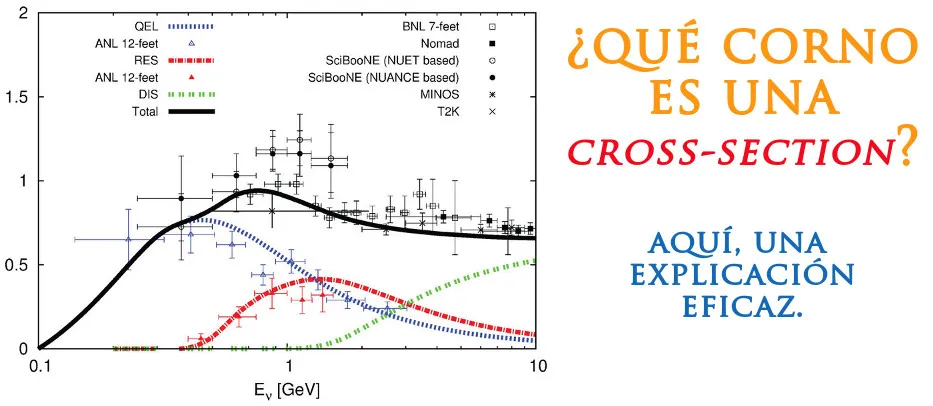
Physicists represent "cross sections" in equations with the Greek letter sigma (σ). With measurements in hand, they make graphs similar to this one:
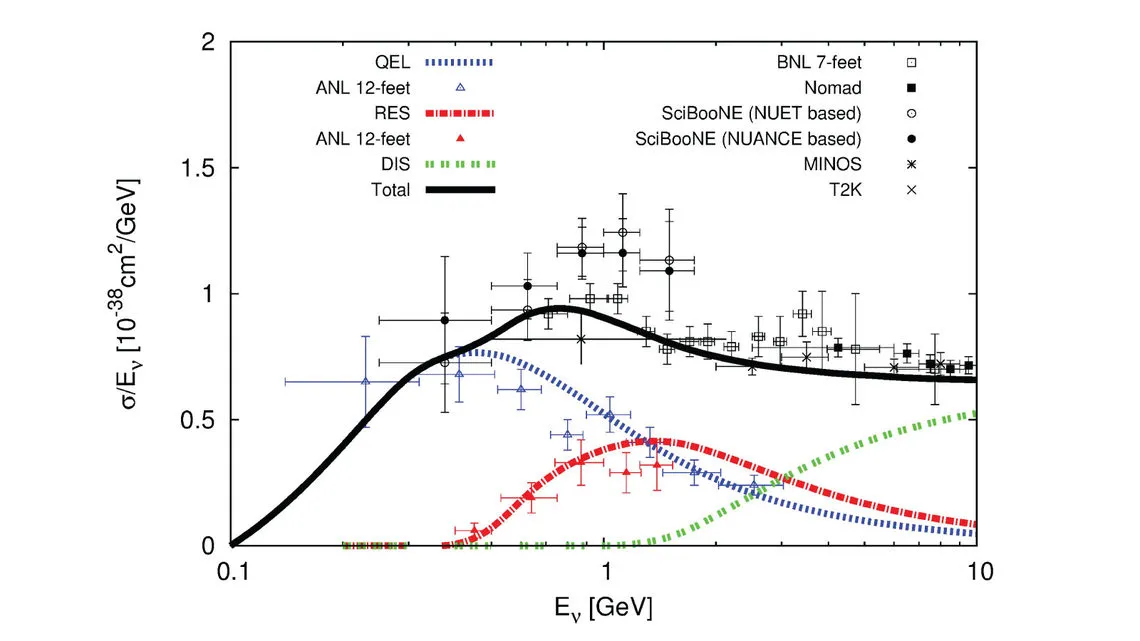
The graph comes from a paper (see below) on interactions between neutrinos and the atomic nucleus. The vertical axis represents the probability of different reactions (measured in square centimeters per giga-electronvolt) and the horizontal axis represents the energy of the neutrinos. An electron-volt is a measure of energy based on the amount of energy an electron gains after being accelerated by 1 volt.
The image above says, for example, that at an energy of 10 GeV the most likely result would be an inelastic reaction (DIS, green line), followed by a resonance state (RES, red line) and then a quasi-elastic reaction (QEL, blue line). The black curve represents the total cross-section.
"What you see in this graph are attempts to find a common way to show results from complex experiments. The graph shows how we divide the events we find in the detectors", explained Jorge Morfín, a physicist at Fermilab and one of the paper's authors.
Since these experiments are done in different laboratories, the results can be compared using these graphs.
"Cross sections" also appear in dark matter astrophysics articles, since it is postulated that this matter is composed of particles and collision experiments are done to see if new particles appear that might match the theoretical characteristics.
In some graphs, the vertical axis will be indicated in Barns or Barnios (and also in megaBarns or PetaBarns) which are a unit of area.
THE NAME GAME
Ahhh...it's a whole science...or an art, that business of naming things. Why on earth are "cross-sections" called "cross-sections"? If we literally translate it as "sección cruzada" (crossed section), what is being "crossed"?
In an article from Fermilab Today, Jim Pivarski tried to explain it. There he says that at the beginning of particle physics, particles were thought of as small, indestructible balls. When you collide marbles, the probability of collision is proportional to their size, unless they are aimed with great precision, like when we played as kids shooting marbles at each other. But that's not possible with subatomic particles. The best you can do is shoot a bunch into the same area. The collision probability for a cloud of projectiles is simply the ratio between the area of the cloud and the total area. When Xerxes darkened the sky with arrows at the Battle of Thermopylae, the probability of being hit by an arrow was very high.
The first collision experiments intended to measure the size of particles from the collision rate. Rutherford's experiment, which collided alpha particles and gold nuclei in 1911, revealed that nuclei were much smaller than thought until then. But disparities soon arose: neutrons have a higher probability of collisions with certain nuclei when moving slowly than when moving fast. It's as if neutrons changed the area of their cross-section mid-flight. Particles like neutrons are quantum clouds that pass through others or interact with a probability that depends on energy. The probability of collision, then, has little to do with a solid cross-sectional area.
Although the idea of little spheres is wrong, the term "cross section" remained and it's common for a physicist to say: "this cross section depends on energy," even though it sounds illogical to imagine the particle's size changing. In Spanish, it's preferable to use the expression "sección eficaz" instead of "sección transversal or sección cruzada" to avoid confusion with other concepts.
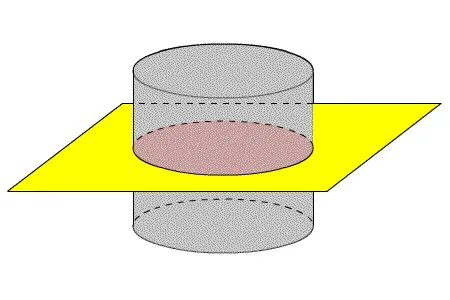
This is a cross-section of a cylinder. But it is not a "cross-section" or sección eficaz.
On a FAMAF page it states: "The cross-section is proportional to the probability that a scattering occurs, and has units of area, due to the chosen way of normalizing it: that's why it's called a section, and often also a cross-section (cross-section)."
Why insist on this concept when alternatives like "probability" or "reaction rate" can be used? "Cross sections" are independent of the intensity and focus of the particle beams, so the numbers from a cross-section obtained in one accelerator can be compared directly with the numbers achieved in another experiment, regardless of how powerful the accelerators are. Arrows are arrows, no matter how many are shot into the sky.
I think Jim Pivarski's explanation is very good. Thanks to the Higgs boson for making physicists who are a blast.☉
Sources and related links
- Speak physics: What is a cross section?
https://www.symmetrymagazine.org/article/speak-physics-what-is-a-cross-section - Recent Developments in Neutrino/Antineutrino - Nucleus Interactions
Jorge G. Morfin, Juan Nieves, Jan T. Sobczyk
https://arxiv.org/abs/1209.6586 - WHAT DO WE MEAN BY "CROSS SECTION" IN PARTICLE PHYSICS?
https://cms.cern/news/what-do-we-mean-cross-section-particle-physics - Fermilab Today, 1-3-2013
https://www.fnal.gov/pub/today/archive/archive_2013/today13-03-01.html - https://es.wikipedia.org/wiki/Secci%C3%B3n_eficaz
- https://www.famaf.unc.edu.ar/~gcas/cuantica2/clases/node45.html
About the images
Image 1. Credits: Jorge G. Morfín , Juan Nievesb , Jan T. Sobczyka
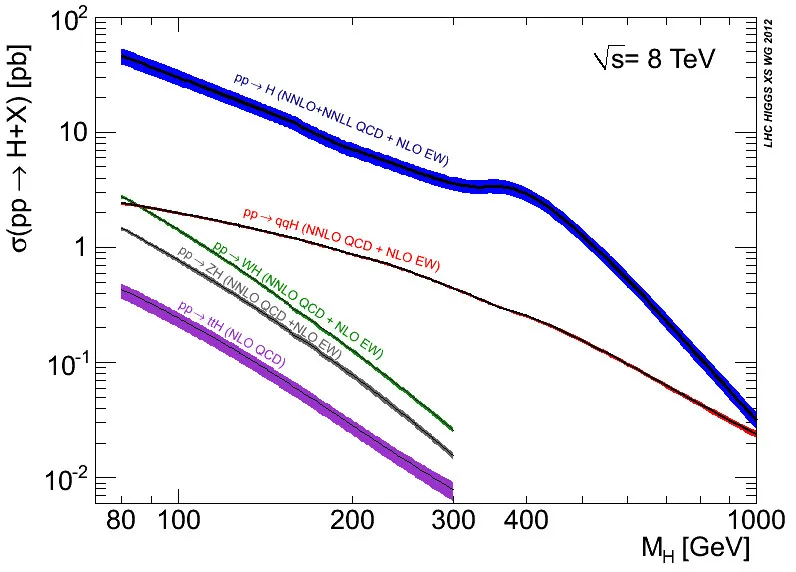
Image 2: LHC: Cross-section for Higgs boson production in proton collisions at an energy of 8 TeV.