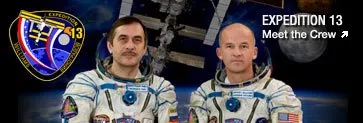
Up there, on the International Space Station, a Russian and an American are living their dream of becoming astronauts when they grew up. Every day, they share life in a few square meters, recycle every last drop of water, and circle the world every hour and a half in a tin can shell 2 millimeters thick. Last week, they chatted with Earth through NASA and Radar was there to interview them.
By Esther Cross
Original interview by Esther Cross from the Radar supplement of Página 12. It can be read in full here.
Pavel Vinogradov and Jeffrey Williams were born in the years of the Space Race and the Cold War. In 1975, a U.S. shuttle and a Russian spacecraft docked in space and exchanged crews in a ceremony that sealed the end of the stellar escalation between powers. Although as kids they lived in enemy countries, today Pavel and Jeff live together 384 km high
They are on the International Space Station and a month ago they chatted with members of the State Alumni Community through a camera connected to NASA TV and from there to computers all over the world.
Williams: We are heading towards the southern tip of South America. Every hour and a half we circle the world.
Pavel and Jeff work to “improve life on Earth and expand it beyond our planet.” It's because we are not safe “from the forces that exist in space” nor from the danger of Earth's ecological coma, attributable, in large part, to some of the countries that make up the alliance. Necessity has the face of a merger even though the union hasn't been easy.
Vinogradov: We use different languages. We learned English, Czech and Russian, but we speak a mixture, not entirely English nor one hundred percent Russian. The crew is made up of members from different countries and cultures, but it's a team, like an organism or a single person.
Up there it seems Babel works. The language of the astronauts is different because their ideas seem different even when they chat in English. Even when they answer questions with a political correctness that can be exasperating, and even though their phrases resemble those from NASA bulletins and Bush's pompous harangues, when they speak it's different. When they speak of the need to cooperate, or when they draw attention to some things, they immediately earn the benefit of the doubt. Nothing they say sounds like easy propaganda. For them, life on the Station and space exploration are not a means of power, but a cause.
Seen from below, the Station is a star. Seen in photos, it's a Meccano made of silver modules. The project of Russia, the U.S., Canada, Japan, Brazil and the countries of the European Space Agency weighs 440 tons and measures 120 meters. Pavel is the commander and Jeff is the flight engineer. They work together but due to the complexity of the station and given the two main sections, the Russian and the American, they were assigned, by default, each to his own segment.
Williams: Our routine is similar to that of any working person. Maybe it's a bit longer than on Earth. We get up at 6, have our time for grooming and breakfast, discuss the day's plan. We finish at 7 in the evening. We record what we did, report any problems and plan the next day. A normal day, like everyone who works on Earth has.
Each day has a schedule that considers the smallest details (the ten minutes of check-up right after getting up, breakfast, private medical reports, even moments of relaxation and time before going to sleep). On the Station there are 18,000 objects and they spend their time tidying up because up there it's better not to lose anything. The astronauts receive a schedule that they follow to the letter. They wash their clothes –inside a bag–, they make do to have a good time with the dehydrated food. As for water, it's better not to know much but it's worth saying that everything is recycled.
Although full of risks and difficulties, life up there has its compensations. Spacewalks are among the best. With their 130 kg suits they float in space, make repairs, prepare the Station for the arrival of other ships and more modules, and have fun.
Williams: We saw the whole world during the 6 hours the spacewalk lasted. Many sunrises and sunsets, the illuminated parts of Earth, what was left under the clouds, it was incredible.
Up there you have to watch and gravitate. They take photos of the ocean and also of the atmosphere when hurricanes form.
Vinogradov: The results of human activity are not always positive. There is pollution in the ocean. We see impressive fires and other things that tell us it's better we evaluate what we are doing to the planet. We, humanity, are the guardians of Earth. From above we can see what cannot be seen down there.
But the guardians of Earth's guardians also observe themselves.
Williams: We investigate how to mitigate the effects that weightlessness causes in the body. In the near future man will work on the surface of other planets and we are preparing the ground for that.
They stay in shape with two hours of exercise a day. They run tied with a harness to a treadmill that floats a few centimeters off the ground. The astronauts' bodies become a field of experiments. The astronauts are monitored from the ground although at night the control centers “don't focus much on the inside of the spacecraft out of respect.”
Vinogradov: The most important part of the expedition is re-entry and landing. When the spacecraft enters the dense air of the atmosphere, it's a very crucial moment for the crew and those waiting for them on Earth. The spacecraft has to withstand a lot of pressure. Its surface heats up enormously (more than 1500 degrees Celsius). In this stage we are especially careful.
But before passing that test comes the moment of leaving the station and entering an incomparable jet lag. They say it's like leaving home. Even though landing is a priority, even though family and friends and life are important, if you've been on the Station you want to go back to it. The sadness is relegated because you have to concentrate on crossing the atmosphere without dying in the attempt like a roasted chicken.
Jeff applied to be an astronaut in 1985 and was only accepted in 1996. Pavel is a Hero of the Russian Federation. Besides being pilots and parachutists, they are engineers. They trained for 18 months and underwent quarantine in Kazakhstan. The trip on the Soyuz rocket to the Station took more than two days. They traveled crammed in a fetal position until the spacecraft began tracking the Station through space. Now they live in a few square meters in a place where it's impossible to leave slamming the door. They submit to a rigorous discipline, are accountable, risk their entire bodies every day. They are aware that their mission is just a step for the history of space exploration. They know that the future of the project they are betting so much on depends on political and financial decisions. They know that on more than one occasion the Station has been threatened with being left incomplete. But they continue. What drives them? Where does such a strong desire, proof against tests, come from?
For Pavel the answer lies in childhood, when his heroes were Gagarin and Armstrong. "I dreamed of that and even though it seemed impossible because astronauts and cosmonauts were unique people at that time, I still believed I could become one." As for Jeff: "I was always interested in science, that's why I wanted to study engineering. I went to the West Point Military Academy, and there I read a book, *The Right Stuff* by Tom Wolfe, which is a history of test pilots and the first space programs and the first astronauts. If I have to choose a book that made me want to take a space trip, it was that one. Many people also inspired and helped me."
Pavel and Jeff have the right stuff: the power to climb and climb and know when to stop and then keep climbing, as Wolfe defined it, to pass increasingly difficult tests for a cause that means something for humanity –humanity formed so far only by a handful of countries–. "For a couple of years now, the Russian government and the U.S. congressmen have not shown the same interest as before," comments Pavel, and it's certain that Jeff agrees. "Many things are forgotten and lose appeal, to the point that today almost no one knows who is in space," says Pavel. His comment hangs in the air like a difficult question. Surely they prefer not to think about that, just as they don't think "that only 2 millimeters of metal protect us from the dangers of space." They continue orbiting Earth in the attempt to "understand the world around us and above all to understand ourselves." It's that they aim at the moon but the idiot, as always, looks at the finger.