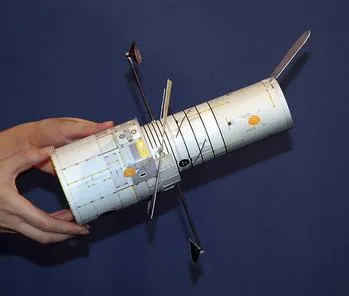
The European Space Agency (ESA) space telescope called Planck was removed last week from the Large Space Simulator (LSS), after a rigorous two-week testing period at temperatures below -178 degrees Celsius. The test is key for its launch in 2008.
Via Astroseti
Once in space, Planck will investigate the cosmic background radiation: the remnants of the Big Bang that took place more than 14,000 million years ago. The telescope will make observations in the far infrared spectrum; this can only be achieved using supercooled instruments. It is essential to test the telescope at these low temperatures, a task very appropriate for ESA's Large Space Simulator.
Cold vacuum
“The main point of this test is the exposure of the mirrors and their structural frame to a very cold vacuum,” explains ESA scientist Philippe Kletzkine. “The telescope is assembled at room temperature, and then cooled well below freezing. Although the materials were carefully chosen, this process causes each individual component of the telescope to shrink by a small, but not insignificant, amount. We need to know if the resulting changes in shape match our predictions. We must be insistent on this, so that the mirrors align correctly.”
Videogrammetry is used to obtain a clearer picture of the changes in the structure. Thousands of photographs, taken from various angles, are used to form a three-dimensional image of the mirrors, the structural frame, and the place where the telescope's cameras are mounted. This process is repeated at various temperatures.
Arithmetic
The telescope has been returned to an empty room at the European Space Research and Technology Centre (ESTEC). This completes the mechanical part of the measurement; now it's time for a little arithmetic. Kletzkine says: “During the next few weeks we will be busy interpreting the test results. According to our first impressions, the telescope has behaved well.”
Some time ago, earlier this year, Planck's mirrors were tested individually without the structural frame at Alcatel, Cannes, France. The results of their videogrammetry matched expectations. The French space company Alcatel Alenia is ESA's prime contractor for the Planck spacecraft.
Preparations for the mission continue at ESTEC. All components needed to complete the spacecraft will be sent and tested together in the coming months. Eventually, the flight model will undergo vibration, acoustic, high and low temperature tests, as well as various rehearsals of the on-board computers and communications equipment.
Spinning
When the satellite is almost complete, it will be placed again in the Large Space Simulator. Planck is one of the so-called 'spinning' satellites, a satellite that spins around its axis. New tests in the LSS, again under vacuum conditions, but this time at normal room temperature, will check that the entire spacecraft is well balanced.
If everything goes as planned, by the end of 2007 Planck will pass its 'flight readiness review': the last step before proceeding with launch activities in 2008. Planck will be launched together with ESA's Herschel spacecraft (which is an infrared space telescope of a different class), by ESA's own heavy-lift booster rocket, the Ariane-5 ECA.