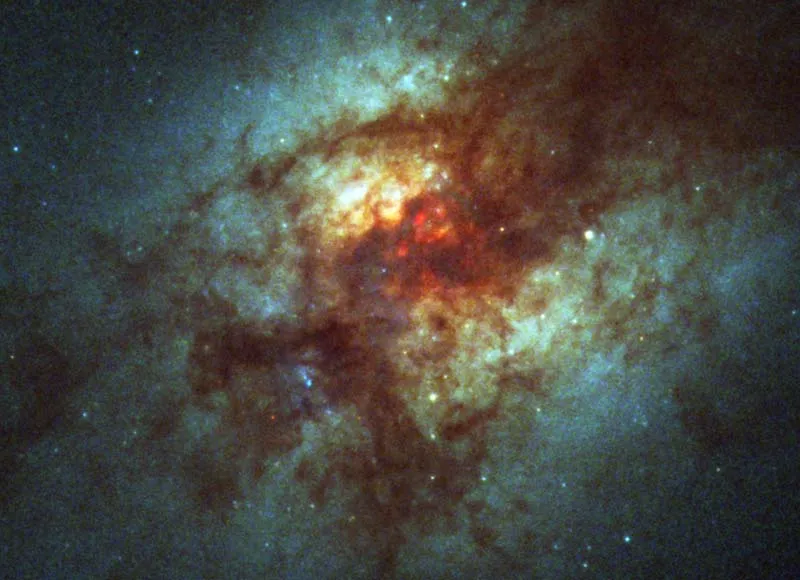
Top Ten Weirdest Cosmologies is an interesting compilation by New Scientist of the ten strangest cosmological theories currently being considered as answers to "what is this Universe we exist in like." This is a small summary I've translated into Spanish of what caught my attention the most. The original has some links about certain details of each theory, which usually lead to paid articles from the magazine itself:
Via Microsiervos
1-Colliding branes. The universe is a brane floating in a higher-dimensional space, colliding with other nearby universes.
2-Evolving universes. Black holes reach extreme densities and create new small universes with slightly different physical laws. We live in one of those universes where the evolution of physical laws optimizes the production of more black holes.
3-Superfluid spacetime. Spacetime is a superfluid substance that flows with zero friction. Vortices give rise to galaxies and the rest of observable matter.
4-The anthropic principle. Many cosmologists do not consider it science because it offers no testable predictions, but this principle states that the universe is as it is because intelligent beings capable of observing it exist within it: us. Inflationary theory suggests there could be infinite universes out there, and string theory that there could be an infinite range of physical laws and properties, but only in those where the values are suitable does the anthropic principle hold and someone exists reading this blog and wondering about the universe they find themselves in.
5-Modified Newtonian Dynamics. Dark matter is actually nothing but a strange behavior of gravity, which holds galaxies together that would otherwise be flying apart. A new formulation of this theory is consistent with relativity, but not with the cosmic microwave background radiation.
6-Phantom presence. A phantom condensate would be a substance capable of producing repulsive gravity, responsible for the cosmic inflation of the Big Bang, which upon clumping together would form dark matter.
7-The universe is small. The universe is actually small and space had to curve back on itself, in the shape of a funnel, which would explain the scarcity of large patches in the background radiation.
8-Fast light. The ends of the universe were never together, so it is somewhat inexplicable, when not even light could travel from one side to the other, that its properties are so uniformly distributed. Perhaps light moved at a greater speed in the past and Einstein's relativity has not always been valid or exact.
9-Sterile neutrinos. Dark matter could be made of sterile neutrinos, similar to ordinary ones and impossible to detect, capable of "heating" dark matter and forming certain groupings, including the formation of black holes and stars at their origin.
10-The Universe is really Matrix. Nick Bostrom of the University of Oxford popularized an argument that drew quite a bit of attention, which suggested the possibility that we are currently living in a computer simulation. Assuming it will ever be possible to simulate consciousness virtually, future civilizations might attempt it, sometimes over and over again. Most of the "apparently perceived" universes if those civilizations come to exist would then be simulations. If this has been happening on a cosmic level for a long time, or if we ourselves in the future come to perform such simulations, it is most likely that our universe is already one of those simulations and that we all live in a kind of Matrix.