The Hubble Space Telescope glimpses an explosive star-forming region in the core of two galaxies that have merged
Via Astroenlazador
Observing the crowded and dusty core of two galaxies that have merged, the Hubble Space Telescope (NASA) has discovered a runaway star-forming region. These two interacting galaxies appear as a single exotic galaxy called Arp 220, a nearby exemplary object of the aftermath generated by galactic collisions. Arp 220 is the brightest of the three galactic mergers near Earth. Its latest image expands the understanding of the early stages of the Universe, when this type of catastrophe was more common.
The sharp vision of the ACS (Advanced Camera for Surveys) camera has revealed the presence of more than 200 oversized star clusters, which greatly exceed in number the six captured in 1992 by Hubble with the lower-resolution WFPC (Wide Field Planetary Camera). The most robust cluster in Arp 220 observed by Hubble contains enough mass to build 10 million suns, which is twice the mass of any other comparable cluster known in the Milky Way.
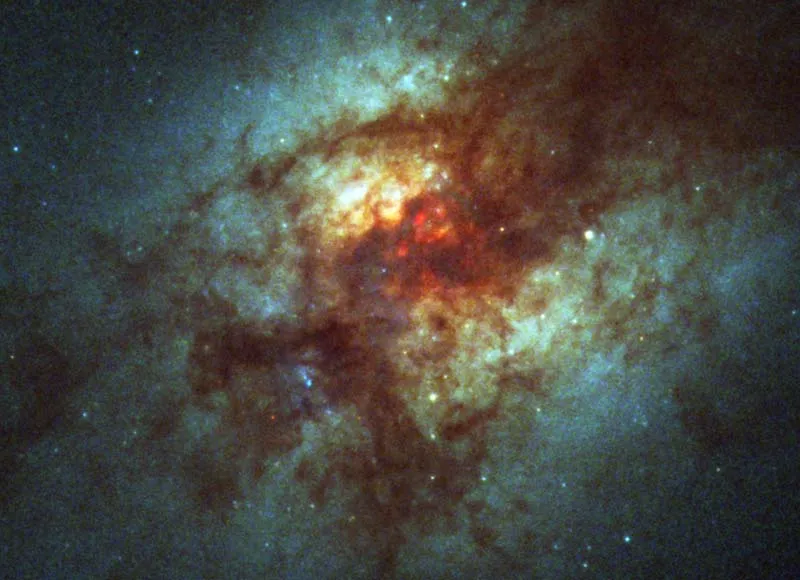
Image: the heart of galaxy Arp 220 through Hubble's ACS camera. The star clusters are the white-blue dots distributed throughout the image, although there are many more not visible, obscured by the dust that engulfs this galaxy. Much of the visible light in this image is reddened for the same reason, similar to what happens with sunlight in our atmosphere at sunset. Arp 220 is located 250 million light-years away toward Serpens. The photograph spans 24 arcseconds, 8900 parsecs or 29,000 light-years at this distance.
However, the degree of compactness of these clusters is such that not even Hubble is able to resolve their individual stars at the moderate distance of 250 million light-years, appearing as extremely bright individual stars, although astronomers know they are clusters because at this distance no star would show such apparent brightness.
This frenzy of star birth occurs in a small region of 5,000 light-years (5% of the diameter of the Milky Way) with a high concentration of gas and dust. This tiny portion of space contains as much gas as our entire galaxy.
The team of Christine D. Wilson, from McMaster University in Hamilton, Ontario, Canada, obtained measurements of the masses and ages of 14 of the clusters, which allowed them to accurately estimate the same magnitudes for all the clusters. The observations revealed two populations of star clusters: one with an age less than 10 million years, the other with an age between 70 and 500 million years. The clusters in the younger group are more massive.
It is still not possible to determine whether there were two different epochs of unstoppable fury of star birth, or whether this frenetic pace takes place continuously but the intermediate-age clusters have not been detected. What is clear is that it was induced by a collision between two galaxies that began 700 million years ago. The effects of the contact have thus lasted for hundreds of millions of years.
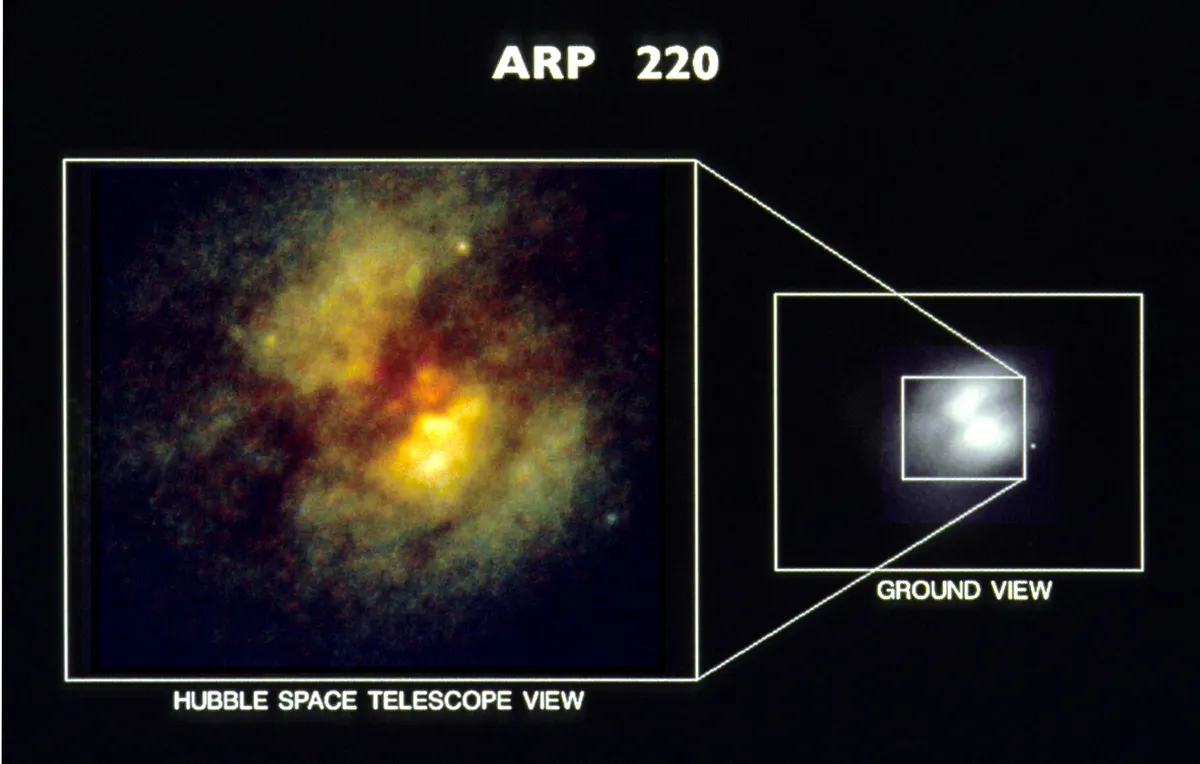
Image: on the right, a photograph of Arp 220 from a ground-based telescope (USNO Flagstaff, Arizona) with a curious double-lobed structure once interpreted as two colliding galaxies; however, later observations with more sophisticated CCD detectors captured a large dust trail responsible for that bilobed appearance. On the left, a Hubble image from 1992 with the WFPC camera reveals a complex structure in a space of 1 arcsecond around the nucleus, where young star clusters of size much larger than any previously observed are detected.
The ACS camera observations taken in visible light in August 2002 exhibit the huge population of clusters and provide the age for the oldest ones. The near-infrared camera handles the youngest clusters. Although in this new image Arp 220 stands out in visible light, the galaxy actually shines brighter in infrared; it belongs to the so-called ultraluminous infrared galaxies or ULIRGs, all of them products of galactic mergers creating huge storms of star formation. The light from the newly born stars heats nearby dust particles, significantly increasing the infrared brightness of these galaxies.
Little optical light manages to escape from a dust-filled galaxy. If astronomers obtained an unobstructed visible-light image of Arp 220, the galaxy would shine 50 times brighter than the Milky Way due to radiation from its massive clusters and associated star formation.
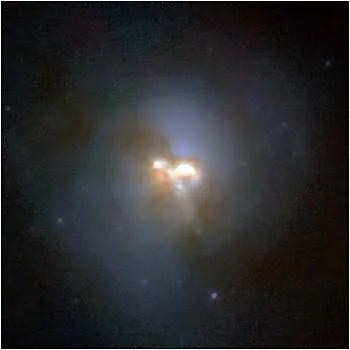
Image: infrared photograph (NICMOS) taken by Hubble in 1997. Red corresponds to longer wavelengths than blue. The bright central crescent-shaped object is the remnant nucleus of one of the colliding galaxies. It contains about a billion stars. The nucleus of the other galaxy is the spherical object appearing to its left.
Arp 220 shares various characteristics with other galaxies in full interaction, such as the well-known Antennae pair, which comprises galaxies NGC 4038 and NGC 4039, located 60 million light-years away toward the constellation Corvus, with two tails extending 360,000 light-years (20 arcminutes in the sky) possibly composed of stars ejected by gravitational interaction.
The process in Arp 220 has gone much further than in the "Antennae," it is even impossible to observe the two galaxies from whose annexation Arp 220 arose. In radio, two objects separated by 1000 light-years are detected that could represent the original nucleus of both galaxies.
Arp 220 will continue manufacturing star clusters until all the gas is exhausted, which at the current rate will happen within 40 million years, a brief period of time when dealing with galactic scales. Then Arp 220 will take on the appearance of the elliptical galaxies we observe today with little gas. Some of the gigantic star clusters, those that are currently 100 million years old, will continue there.
More information:
http://hubblesite.org/newscenter/newsdesk/archive/releases/2006/26/full/