Via La Prensa and Hubblesite
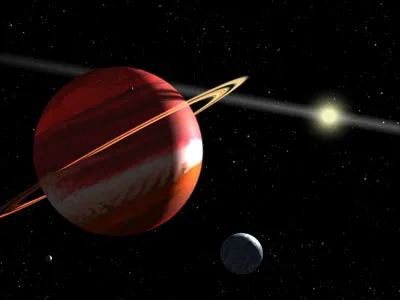
Paris. An international team of astronomers has discovered five new extrasolar planets with characteristics unknown until now, as they complete their orbit in less than one Earth day, according to an article to be published Thursday in the British scientific journal Nature.
Extrasolar planets or exoplanets are part of planetary systems other than our own.
Kailash Sahu, of the Space Telescope Science Institute in Baltimore (Maryland, United States), and his colleagues from the United States, Chile, Sweden, and Italy believe they could be a new type of planet, which they call "ultra-short-period planets" (USPP).
Over the last ten years, astronomers have located more than 200 orbiting planets in systems other than the solar system. The fastest of them take between 1.5 and 2.5 Earth days to complete their orbit.
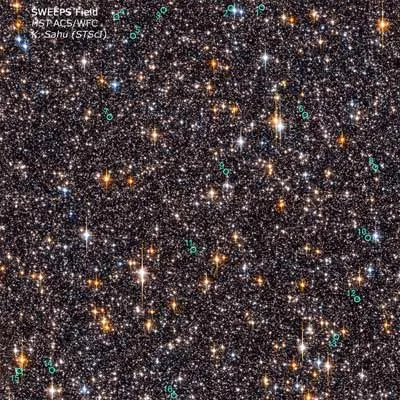
Sahu and his team have focused their research on a portion of the galactic bulge, the central region of our Milky Way rich in stars, in the Sagittarius region. Thanks to the Hubble Space Telescope, they have located 16 possible extrasolar planets.
The astronomers have used a method consisting of locating these planets when they pass in front of their star. The passage is detected by the dimming of the star's brightness.
Their existence must now be confirmed by another method, not always applicable. However, Sahu and his team are convinced that at least seven of the 16 detected objects are planets and not stars nor "brown dwarfs" (failed stars).
The fastest of the possible extrasolar planets orbits its star in 0.42 Earth days.