Dante Minniti belongs to the group in the Department of Astronomy of the
Pontifical Catholic University of Chile. During the past annual meeting of Argentine astronomers he shared topics he is working on together with colleagues from several countries. The increasingly numerous extrasolar planets are in the sights of these astronomers, or rather, they are part of an ambitious plan whose "eyes" are the Subaru, Magellan, and Keck telescopes.
Planets like Jupiter but outside our solar system.
Via Newsletter Year 5 Number 185 of the La Plata Astronomical Observatory
Text writing and interviews: Jour. Alejandra Sofía
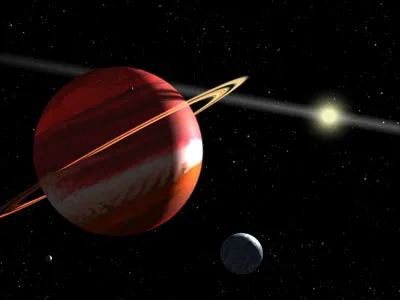
Dr. Minniti spoke about a class of planets called "hot Jupiters" and explained their characteristics.
"They are planets that are very close to their parent stars and their surface temperature is quite high, they are so close that their discovery was surprising, they were the first to be discovered, their orbits are circular and they are planets with periods of less than 10, 15 days, they are the easiest planets to discover with radial velocities.
The advantages they have are that the probability of transit is quite large, on the order of 10 to 15%; transit means that the planet passes in front of the star and that gives us additional information which is the measurement of the planet's radius; from radial velocities we will have masses and from transits we will have radii.
Having masses and radii we determine densities of these planets and knowing more physical parameters we can test models. The classic example discovered about five years ago is HD209458."
"Hot Jupiters have many advantages, for these formation models, they give us the boundary conditions, they test the orbital migration of planets that are forming, the evolution of the disk, a lot of information like the search for other planets in these systems and they also allow us to test non-Keplerian interactions, besides there are statistical anomalies like a stacking of periods at three days. Apparently planets that have transit have lower mass than planets traditionally at greater distance and they live in stars of a little more than one solar mass."
Stars with metallicities have more chance of having planets
"What we want to do is a new search and for that we want to search the next 2000 stars. You know that North American and Swiss groups are monitoring 2000 stars in the solar neighborhood, they are bright stars, of magnitude less than 7 and we go a little deeper, not only stars a little fainter but we also take advantage of the relationship between the star's metallicity and the planetary frequency which is very marked; stars richer in metals than the Sun have many more probabilities of having planets than stars less rich in metals than the Sun.
So, one can concentrate the search on super-metallic stars and the frequency of planets that one will find is much higher. We want to search in 2000 new stars between magnitudes 7 and 9. It is a very ambitious project, for that we need twenty nights per year of telescopes of the eight-meter class, clearly that's why it is a consortium; several of us got together and it is already working. We are concentrating on high-metallicity stars and the idea is to find new hot Jupiters with radial velocities and a subsample of those will be Jupiters that transit."
"We use the Subaru, Keck, and Magellan telescopes. At the Subaru
telescope they have given us a lot of time but we have some difficulties measuring radial velocities; the 'Keck' I like a lot but where I like to observe most is at 'Magellan' where there is a great friend who serves me mate! (Dr. Nidia Morrell)."
"The idea is quite interesting -continued Dr. Minniti- we observe about 100 stars per night, they are magnitude 8 more or less, we make three or four consecutive measurements on consecutive nights, right there we discard binary stars, those with high rotation and we are left with a clean sample."
"Velocities are measured with precisions that are on the meter per second, at 'Magellan' they are at three meters per second and velocity distributions are made. Most stars that do not have planets will not have velocity variation but those that do, will have velocity variations of some tens of meters per second and those three measurements easily pick them out. Other stars are at 500 meters per second, they are binaries and are discarded."
What's coming
Dante Minniti added that "in a progress report several new planet candidates are shown, it was done at 'Keck' from two years ago and we already have 400 stars of which more than 350 have more than three velocities meaning we have candidates, we have on the order of 40 planet candidates and of those some could be transits. At 'Subaru'
there are more, there are many Saturn candidates among about 600 stars measured."
"At 'Magellan' fewer stars have been studied -almost 300 counting those from a few weeks ago- of which half have more than three velocities meaning we already have a list on the order of a dozen good candidates. It is an ultra-secret list but yes, there are very good candidates and five are hot Jupiters."
"In the end we will find about 60 planets in total, some discoveries have already been published, a hot Saturn has already been published in HD88133, they are observations made at the Keck telescope, the radial velocity curve is very well defined, also HD109749 and HD149143: one is a
hot Jupiter, the other is a hot Saturn."
"You realize that we have more incidences of hot Saturns. Of the five planets from 2005 we were surprised that there were three hot Saturns, that should not have happened and we have to see if it persists through the sample. To finish, N2K carried out in consortium with other institutions is the project to observe 2000 stars and is well advanced. We have the first planets, some papers have already been made, there are more to come.
This detection is very interesting, the incidence is very high in the combination of radial velocities and more metallic stars."