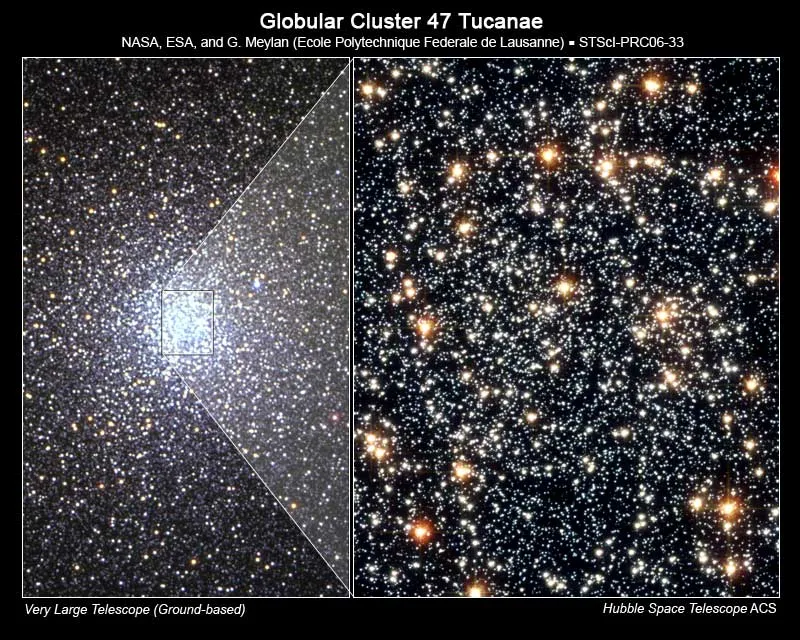
NASA's Hubble Space Telescope has provided astronomers with the best observational evidence to date that globular clusters sort themselves out according to the mass of their stars governed by gravity.
Via HubbleSite
The heaviest stars sink to the heart of the cluster, while the lighter ones gain speed and move through the cluster. This process, called "mass segregation," has long been suspected but had never been seen in action.
A typical globular cluster contains many hundreds of thousands of stars. While the density of stars is very low in the outskirts of these systems, the stellar density near the center can be more than 10,000 times higher than in the local neighborhood of our Sun. If we lived in a region of space like that, the night sky would glow with 10,000 stars that would be as close to us as the closest star to the Sun, Alpha Centauri, which is 4.3 light-years away (or approximately 215,000 times the distance between Earth and the Sun).
This stellar multitude strongly increases the probability of encounters between stars, including collisions and mergers. The cumulative result of that number of encounters is the theoretically expected mass segregation. But at the same time, these crowded conditions make it extremely difficult to accurately identify individual stars.
Astronomers had to wait for Hubble's extreme visual acuity to track the movements of many thousands of stars in a globular cluster. Now, high-precision velocities have been measured for 15,000 stars in the center of the nearby globular cluster 47 Tucanae - one of the densest in the southern hemisphere. A small number of these stars are of a special type known as "blue stragglers" (blue stragglers): unusually hot and bright, they are thought to be the product of a collision between two normal stars.
The velocity of the blue stragglers agrees with the predictions of mass segregation. In particular, a comparison between blue stragglers (which have twice the mass of an average star) and other stars shows that, as expected, they move more slowly than regular stars.
Using Hubble's Wide Field and Planetary Camera 2 and the new Advanced Camera for Surveys, Georges Meylan of the Ecole Polytechnique Federale de Lausanne (EPFL) in Sauverny, Switzerland and collaborators, took ten sets of multiple images of the central region (with a distance of about 6 light-years from the center) of 47 Tucanae. The images were taken at regular intervals over about seven years. By carefully measuring the positions of up to 130,000 stars in each of the photographic exposures, even small positional changes over time could be detected. Precise velocities were obtained for about 15,000 stars in the cluster. Of the 15,000, 23 were blue stragglers.
This is the largest sample of velocities ever gathered for a globular cluster in the Milky Way. The results were also used to check for the existence of black holes at the center of the cluster, by observing their gravitational pull. But the measured stellar motions rule out a very massive black hole.
With these observations, Hubble has accomplished in less than a decade what ground-based telescopes would have taken nearly a century to do due to the poor conditions obtained from the ground. The study would have been impossible without Hubble's visual acuity. From the ground, the blurring effect of the atmosphere smears the image of numerous stars in the crowded heart of the cluster. The typical angle of motion found for the normal stars in the center of 47 Tucanae is more than 10 millionths of a degree per year. This means the angle of motion of a star in one year is equivalent to the angular size of a dime seen as if it were 4,500 miles away.
To fully take advantage of Hubble's exquisite images, astronomers developed new data analysis methods, which eventually provided them with velocity measurements corresponding to changes in star positions at a level of 1/100 of a pixel in Hubble's digital cameras.
The results were published in Astrophysical Journal Supplement Series, in September.
The international team was composed of the following scientists:
D.E. McLaughlin (University of Leicester), J. Anderson (Rice University), G. Meylan (Ecole Polytechnique Federale de Lausanne), K. Gebhardt (University of Texas at Austin), C. Pryor (Rutgers University), D. Minniti (Pontificia Universidad Catolica), and S. Phinney (Caltech).