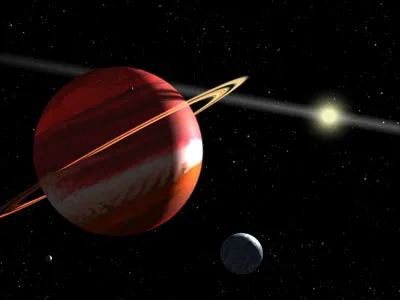
Using a network of small, automated telescopes, known as HAT, astronomers have discovered a planet unlike any other known world. This new object, designated HAT-P-1, orbits a member of a pair of stars located 450 light-years away.
Via La Flecha
Source: SOLOCIENCIA.COM
Gaspar Bakos, from the Center for Astrophysics (CfA), part of the Smithsonian Institution and Harvard University, believes we might be seeing a new class of planet. Bakos designed and built the HAT network and is one of the authors of the discovery.
With a radius 1.38 times that of Jupiter, HAT-P-1 is a very large planet. Despite its great size, its mass is only half that of the largest planet in the solar system.
This planet has approximately a quarter of the density of water. In other words, it is lighter than a giant cork ball. Like Saturn, it could float in a bathtub if one could be found large enough to hold it, only it would float almost three times higher.
The parent star of HAT-P-1 is a member of a binary star system called ADS 16402 and is visible with binoculars. The two stars are separated by a distance equivalent to about 1,500 times that between Earth and the Sun. The stars are similar to the Sun but slightly younger. They are estimated to be about 3,600 million years old, while the Sun is 4,600 million.
Although it is the strangest extrasolar planet found to date, HAT-P-1 is not alone in its low-density status. The first planet discovered to transit its star, HD 209458B, is also "inflated" about 20 percent more than theory predicts. HAT-P-1 is puffed up 24 percent more than expected.
"Of eleven known transiting planets, now there are not just one but two planets substantially larger and less dense than theory predicts. HD209458b cannot be dismissed as a fluke. This new discovery suggests something may have been missed in our theories about how planets form," emphasizes research co-author Robert Noyes, of the CfA.