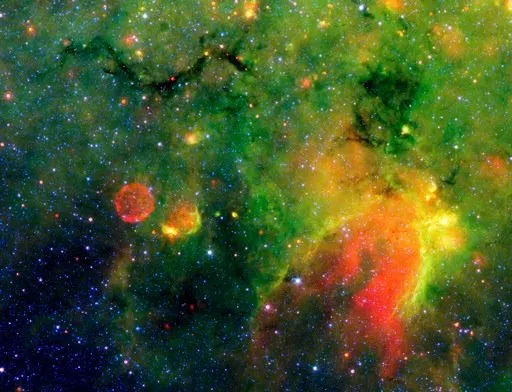
The Spitzer photograph contains several nebulae located in the galactic plane of the Milky Way. The dark nebula, shaped like a serpent, at the top left, contains dozens of huge newborn stars, some with 50 times the mass of our Sun.
Via UniverseToday
The red sphere in the image is a supernova remnant. Before it exploded, the central star probably played a role in creating the dark nebula in the region.
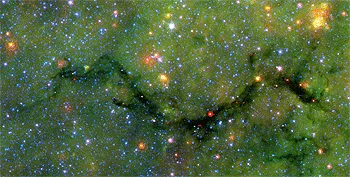
Spitzer was able to see the sinuous cloud using its temperature-seeking infrared vision. The object is hidden in the dust plane of our galaxy, invisible to optical telescopes. By its heat, or infrared light, it peers through the dust. The cloud is so full of dust that if one could somehow be transported into the middle of it, one would see nothing but blackness, not even a star in the sky!
Spitzer's new view of the serpent provides the best look at what hides inside. The yellow and orange dots located in and around the cloud are massive stars that are just taking shape. The bright red dot in the serpent's "belly" is a monstrous stellar embryo, with around 20 to 50 solar masses.
Astronomers said these observations can, ultimately, help them understand how massive stars form. By studying the clustering and mass range of the stellar embryos, they hope to determine if the stars were born in the same way as our less-massive star the Sun -from the collapse of gas and dust- or by some other mechanism in which the environment plays a more important role.
The serpent is located 11,000 light-years away, in the constellation Sagittarius.