On Wednesday, November 8, the planet Mercury will pass directly in front of the Sun. Prepare your observations.
Via Ciencia@NASA
October 20, 2006: Mark your calendar: On Wednesday, November 8, the planet Mercury will pass directly in front of the Sun. The transit will begin at 2:12 pm EST (Eastern Standard Time) [11:12 am PST (Pacific Standard Time), 7:12 pm GMT (Greenwich Mean Time)] and will last almost five hours. Good views can be obtained from the American continent, Hawaii, Australia, and across the Pacific Basin: visibility map over the planet.
What will it look like? A picture is worth a thousand words:
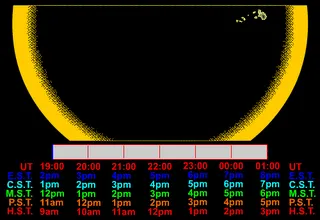
During the transit, the tiny disk of Mercury—jet black and perfectly round—will slowly slide across the face of the Sun. Only a tiny bit of the solar surface is actually covered, so looking at the Sun remains as dangerous as ever. But with a proper filter and a bit of imagination, the Mercury Transit can be a wonderful experience.
There are many ways to observe the Sun safely. For example, through eclipse glasses or with a solar projector. In this case, nothing is better than a telescope equipped with an H-alpha solar filter. H-alpha filters precisely capture the red glow of solar hydrogen. They show us the Sun as a boiling inferno, streaked with dark magnetic filaments and dotted with sunspots. Warning: The sight of Mercury sailing across the Sun's surface may take your breath away.
Teachers, call your local astronomical associations and ask if they have a solar telescope like that. Amateur astronomers love to show off the sky, and probably one of them will volunteer to bring their telescope to class during the transit. (You can also watch the transit online, at the SOHO portal link—no telescope required).
Here is something to think about while watching the transit: Mercury is fantastically mysterious. More than half of the planet is unknown to us. When Mariner 10 flew by in the mid-1970s, it could photograph only 45% of Mercury's cratered surface. What is on the other side? More craters? Or something totally unexpected? We are free to speculate, because the next spacecraft to visit Mercury, NASA's MESSENGER probe (in Spanish, ``Messenger''), will not enter its orbit until 2011.
One of Mercury's greatest secrets is the mysterious material at its poles. Earth's radars have probed Mercury and received a strong echo coming from the polar craters. A common explanation is ice. While Mercury's daytime surface heats up to 400° C, the temperature in the deep, dark polar craters drops below -200° C. If an icy comet landed in one of those craters (or formed one of those craters), the comet's ice, vaporized by the impact, could refreeze and stay there. As skeptics say, however, "it's just a theory," one of many that MESSENGER will test.
Another enigma are Mercury's wrinkles. Geologists call them "lobate scarps." Like wrinkles on a raisin, the scarps are thought to be a sign of shrinkage. Mercury might actually be sinking in on itself as its huge iron core cools and contracts. To test this hypothesis, MESSENGER will map Mercury's magnetic field, which originates in the core. If the core is collapsing, this shrinkage could leave clues in the planet's magnetism. MESSENGER will also look for lobate scarps on the unknown part of Mercury to see if this is truly a global phenomenon.
The answers are years away. Meanwhile, we can observe and marvel, and November 8 is a good date for that.
------
Credits and Contacts
Author: Dr. Tony Phillips
NASA Official: Ron Koczor
Production Editor: Dr. Tony Phillips
Curator: Bryan Walls
Media Relations: Steve Roy Spanish Translation: Edmon Levon / Carlos Román
Spanish Editor: Héctor Medina
The NASA Marshall Space Flight Center Science Directorate sponsors the Science@NASA Internet Portal which includes Ciencia@NASA. The mission of Ciencia@NASA is to help the public understand how exciting the research conducted at NASA is and to collaborate with scientists in their outreach work.
This article was translated into Spanish with the support of Astroseti.org
To see at the Planetarium: November 8
Mercury Transit in front of the sun. On the esplanade from 16:30 to 19:00 h. Observation by telescope.