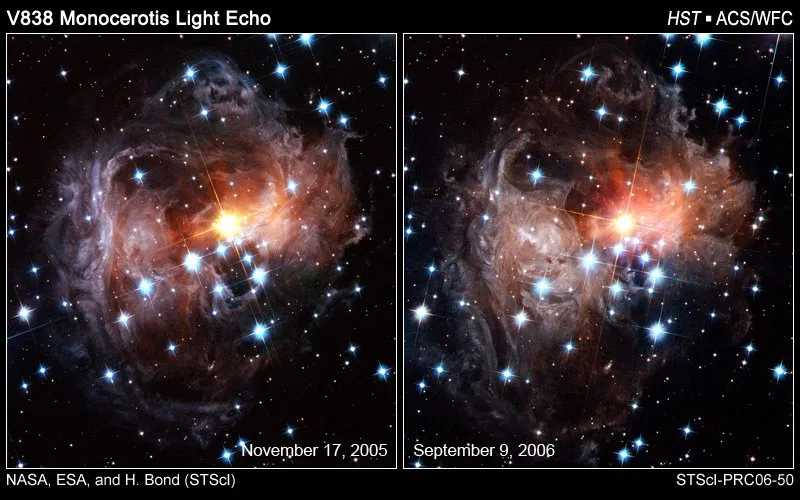
The star V838 Monocerotis recorded an explosion in early 2002, during which it increased its brightness to become 600 thousand times brighter than our Sun
Via El Universal and HubbleSite
Demian Magallán
El Universal
Sunday, October 29, 2006
The cameras of the Hubble Space Telescope were again pointed toward the intriguing variable star V838 Monocerotis, and obtained the two most spectacular images of the light echo surrounding this star in our Milky Way.
The unusual star V838 Monocerotis (V838 Mon) continues to intrigue astronomers.
This previously unremarkable star recorded an explosion in early 2002, during which it temporarily increased in brightness to become 600 thousand times brighter than our Sun.
The light generated by this sudden eruption illuminates the interstellar dust surrounding the star, producing the most spectacular 'light echo' in the history of astronomy.
As the light from the eruption propagates toward the cosmic dust, it is deflected on its journey to our Earth.
The scattered light has traveled an extra distance compared to the light that reaches Earth directly from the stellar explosion.
Such a 'light echo' is the optical analogy of the sound echo produced in mountains.
The telescope operated by the space agencies of the United States and Europe has observed the light echo of V838 Monocerotis since 2002. Each new observation of the light echo reveals a new and unique 'thin-section' through the interstellar dust surrounding the star.
The images released today show the light echo captured in November 2005, and in September 2006.
The Hubble observations were used to determine the distance of this star, using a technique based on the polarization of the reflected light.
Hubble has polarizing filters that only filter light vibrating from certain angles.
This method has determined that V838 Monocerotis is 20 thousand light-years away, which suggests that during its explosion it was one of the brightest stars in the Milky Way.
Although the causes of the explosion continue to be a mystery, some astronomers have suggested it could have been the result of the collision of two stars.