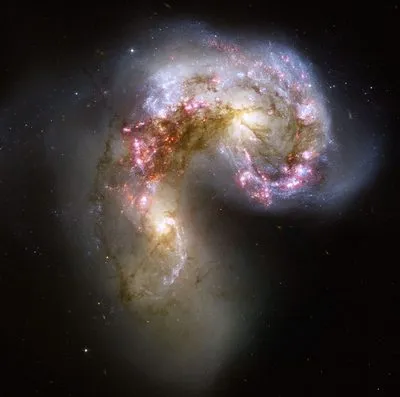
The Andromeda galaxy, the closest spiral galaxy to the Milky Way, appears calm and peaceful as it rolls through space. But appearances can be deceiving.
Via UniverseToday
Astronomers have new evidence that Andromeda was involved in a violent collision with its neighboring galaxy Messier 32 (M32) more than 200 million years ago.
"Like a C.S.I. team, we gathered evidence and reconstructed the crime scene," said Pauline Barmby (Harvard-Smithsonian Center for Astrophysics), a member of the research team that made the discovery.
The discovery was reported in the October issue of Nature.
Evidence of the galactic crash came from images taken by the infrared camera (IRAC) on NASA's Spitzer Space Telescope. Those images reveal a never-before-seen dust ring in Andromeda. Combined with a previously observed outer ring, it suggests a past disturbance whose effects are still expanding through the galaxy.
"These dust rings are like ripples in a pond," said David Block (University of the Witwatersrand, Johannesburg), who is the lead author of the paper. "Throw a stone into the water and you'll get a series of rings or waves. Let a small galaxy collide head-on with a large galaxy, and you'll see waves or rings of gas and dust propagating outward as a result of the violent gravitational interaction."
"While our Atlantic Ocean was forming, M32 entered the disk of gas and stars of Andromeda."
Research team members Frederic Bournaud and Francoise Combes (Observatoire de Paris) conducted a series of computer simulations to recreate the collision between the two galaxies. They found that M32 plunged through Andromeda's disk along the polar axis, approximately 210 million years ago. Since M32 is much less massive than Andromeda, the latter was not substantially altered, but the small galaxy lost more than half of its initial mass in the course of the collision.
Astronomers have predicted that Andromeda and the Milky Way will collide in approximately 5 to 10 billion years. The crash will erase the separate identities of each galaxy, leaving a single elliptical galaxy in its place.
The discovery was made with Spitzer's infrared camera, but previously at NASA's Goddard Space Center in Greenbelt, Maryland.
More information at
Harvard-Smithsonian Center for Astrophysics.