The Antennae galaxies began to collide 200 or 300 million years ago, and offer clues to what could happen with the Milky Way when it collides with the neighboring Andromeda, as is expected to happen in several billion years
Via HubbleSite, Various Media, Reuters
WASHINGTON.- What appeared to be a violent collision of two galaxies has turned out to be a fertile 'marriage' that has allowed the birth of billions of new stars. A phenomenon from which astronomers have been able to obtain a detailed image thanks to the Hubble Space Telescope.
The new image of the Antennae galaxies will allow scientists to work with Hubble to distinguish between the constellations that formed them and the newly born stars.
Most of these constellations, created by the collision, will disperse within 10 million years, but around a hundred of the largest will become 'globular clusters', large groups of stars found in numerous galaxies, including the Milky Way.
These galaxies, located 68 million light-years from Earth, began to merge about 500 million years ago. The image taken serves as a forecast for a probable collision of the Milky Way with its neighbor Andromeda, located about 6,000 million light-years away.
Nearly half of the faintest objects in the Antennae image are small clusters containing tens of thousands of stars.
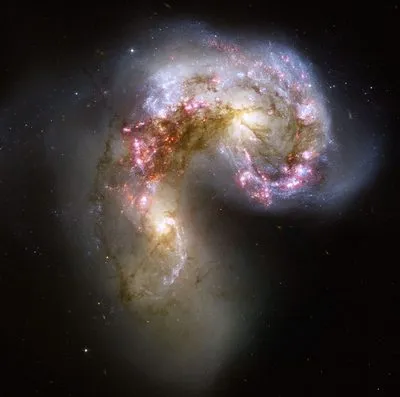
The orange-colored regions to the left and right of the center of the image are the two cores of the original galaxies and consist mainly of old stars among filaments of dust, which makes them appear brown in the image.
Both galaxies are endowed with bright blue regions where stars are forming, surrounded by hydrogen gas, which gives rise to the pink-colored regions in the image.
The new image allows astronomers to better distinguish between the stars and the super star clusters created in the collision of two spiral galaxies.
Astronomers estimate that only about 10 percent of the recently formed super star clusters will survive more than 10 million years.
The vast majority of the super star clusters formed during the interaction will disperse, and their individual stars will become part of the extended background of the galaxy.
However, it is thought that about 100 of the most massive clusters will survive to form regular globular clusters, similar to those found in our Milky Way.
The Antennae galaxies began to collide 200 or 300 million years ago, and offer clues to what could happen with our galaxy when it collides with the neighboring Andromeda, as is expected to happen in several billion years.
----------