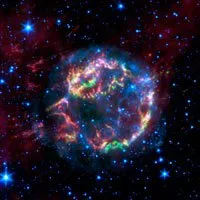
The infrared space telescope "Spitzer" has solved the mystery of the star "Cassiopeia A", which did not maintain its basic structure after the cosmic explosion that turned it into a supernova, said today the Jet Propulsion Laboratory (JPL) of NASA.
Via UnionRadio and Spitzer Space Telescope
"Essentially, Spitzer has found the missing pieces of the Cassiopeia A puzzle," said Jessica Ennis, a scientist at the University of Minnesota and author of a report on the discovery.
According to Lawrence Rudnick, another participant in the research, the images produced by the space observatory "teach us that the star's explosion was not chaotic enough to turn it into rubble."
Cassiopeia, a star 15 or 20 times larger than our sun, became a supernova after an explosion recorded in the galaxy a short time ago in astronomical terms.
Like all such massive stars, Cassiopeia was formed by a series of layers according to the weight of its elements.
The top layer consisted of the lightest elements, hydrogen. In the middle were some heavier ones, like neon, and in the core the heaviest ones were grouped, like iron.
The theory indicated that if the explosion was uniform, those layers should have been ejected uniformly as well.
However, previous observations indicated an alteration in those layers.
The problem was solved by the infrared images from "Spitzer" which revealed that some regions of each stage were not ejected from the star at the same speed.
According to William Reach, of NASA's Spitzer Space Center, the images transmitted by the observatory, which are based on the temperature changes of the layers, allow reconstructing the explosion of a star and its conversion into a supernova.
"It seems that most of its original layers moved into the cosmos in a successive order, but at different speeds depending on the point from which they had departed," said Reach.
For astronomers, the study of Cassiopeia A is ideal for learning what they call "the anatomy" of a supernova explosion.
Because that star is young and relatively close to the solar system, that cosmic event can be seen by telescopes.
In a few hundred years, its remains will have mixed and the most important clues about the birth and death of that star will have been lost, JPL noted.