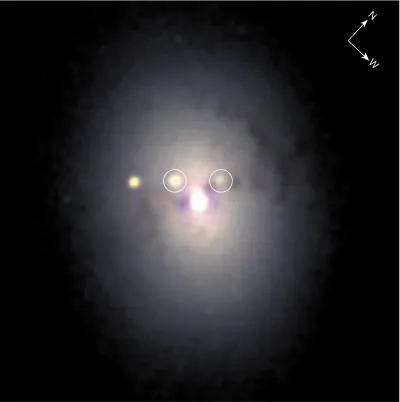
Caption: Twin star explosions fascinate astronomers.
Credit: Credit: NASA/Swift/Stefan Immler
Usage Restrictions: None
Related news release: Twin star explosions fascinate astronomers
Scientists using NASA's Swift satellite came across a strange sight: two supernovas, side by side in a galaxy.
Via Eurekalert
Large galaxies host about three supernovas per century. But in galaxy NGC 1316 there have been two explosions in less than 5 months, and a total of 4 in 26 years, at least as far as has been recorded. This makes NGC 1316 the most prodigious producer of supernovas.
The first supernova, still visible on the left of the image, was detected in June of this year and named SN 2006dd. The second one, on the right, was detected on November 5 and was called SN 2006mr. The bright central point is the galactic nucleus.
NGC 1316, an elliptical galaxy, is about 80 million light-years away, it recently merged with a spiral galaxy. The four explosions appear to be of type Ia, a variety that previously was not associated with galactic mergers and massive star formation. Scientists are intrigued and investigating whether the supernova production rate is a coincidence or the result of the merger.
More on the topic:
Article by Mariano Ribas "Cuando chocan..." in Página/12