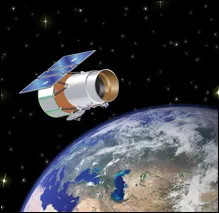
The infrared telescope AKARI, a mission of the Japan Aerospace Exploration Agency (JAXA) with participation from ESA, is about to complete its first all-sky survey. During this mission phase, AKARI has provided what is so far the inspectionthe survey of the Large Magellanic Cloud that covers the most wavelengths, as well as new and fascinating images of this galaxy.
Via La Flecha
The infrared telescope AKARI, a mission of the Japan Aerospace Exploration Agency (JAXA) with participation from ESA, is about to complete its first all-sky survey. During this mission phase, AKARI has provided what is so far the inspectionthe survey of the Large Magellanic Cloud that covers the most wavelengths, as well as new and fascinating images of this galaxy.
The Large Magellanic Cloud is a neighboring galaxy of the Milky Way, the galaxy to which the solar system belongs. It is a very close galaxy in astronomical terms: it is at a distance of 160,000 light-years. It contains about 10,000 stars, around one-tenth of those that make up the Milky Way.
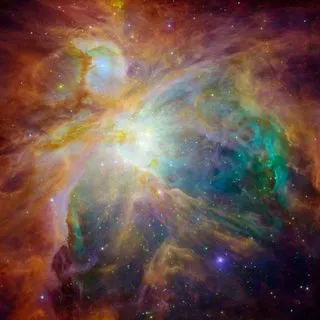
The first image was obtained in far-infrared with the 'Far-Infrared Surveyor' (FIS) instrument. It shows the distribution of interstellar matter - dust and gas - across the entire galaxy. The dust grains in these interstellar clouds are heated by the light of newly born stars and re-emit this energy as infrared light. The infrared emission is therefore an indication that star formation processes are very active.
The contrast between the distribution of interstellar matter and stars also provides information about the nature of the Large Magellanic Cloud. The interstellar matter forms a disk-shaped structure, while the stars are forming an axis in the lower half of the image. This shows that both components are clearly separated from each other.
Astronomers believe it has been the gravitational force exerted by our own galaxy, the Milky Way, that has given rise to both the observed star formation and the separation between the constituent elements of the Large Magellanic Cloud.
The bright region in the lower left part of the image is known as the 'Tarantula Nebula'. It is a very productive star factory.
These and other data obtained by AKARI will reveal how both the Large Magellanic Cloud and our own galaxy have formed and evolved to their current state.
AKARI was launched on February 21, 2006. Its all-sky survey observations began in May 2006. The first survey will be completed in November of this year. According to current estimates, about 70 percent of the entire sky has already been observed by AKARI.
For more information: Akari
Jaxa