A composite image obtained jointly by NASA's Hubble and Spitzer space telescopes shows the appearance of the well-known Orion Nebula and the stars of the Trapezium
Via Multiversos and Astroenlazador
as if it were an abstract painting. The image corresponds to the appearance of this nebular region observed in both infrared and ultraviolet and visible light. Wrapped in masses of gas and dust are hundreds of young stars that emit intense ultraviolet light and powerful stellar winds.
The Orion Nebula is an object easily located in the night sky. It is visible from northern latitudes during autumn, winter, and part of spring and is easy to identify with the naked eye without the need for optical instruments. However, observing it with binoculars or telescopes means contemplating a beautiful spectacle delving into the most recent history of our galaxy. The nebula is located 1,500 light-years from Earth, being one of the closest "star formation factories" to us. Scientists calculate that it contains more than 1,000 young stars.
At the heart of this immense cloud are four stars collectively called "The Trapezium". Their luminosity is 100,000 times brighter than our Sun and in the image they appear as a yellowish blur near the center of the set. The green wisps were photographed by Hubble and consist of gaseous hydrogen and sulfur heated by the intense ultraviolet radiation from the Trapezium stars.
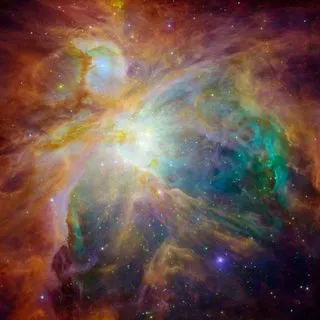
On the other hand, the red and orange wisps, detected by Spitzer, indicate the presence of infrared light from clouds containing carbon molecules.
Other stars in the Orion Nebula are scattered throughout the image like a rainbow of colors and are nothing more than very young stars detected by Spitzer, wrapped in nebular globules of dust and gas (orange and yellow dots). Other similar bodies, but with a less dense gaseous covering, are also seen with greenish colors, while the background stars show blue tones.
This image is a composite of several shots obtained at different wavelengths: light detected at wavelengths of 0.43, 0.50, and 0.53 micrometers is shown in blue; that of 0.6, 0.65, and 0.91 micrometers, in green, while that of 3.6 and 8 micrometers in orange and red, respectively.
More information:
News at NASA
Hubble Panoramic View of Orion Nebula Reveals Thousands of Stars
Video: Hubble Minute: Hubble Snaps the Clearest View of the Orion Nebula