The Iranian millionaire relives her adventure as the first space tourist. And she says humanity's destiny will be to live among the stars.
By Anousheh Ansari, Businesswoman and space explorer
Via News
Earth looks gloriously beautiful from space. Looking from the International Space Station (ISS) at about 400 kilometers high, I saw no borders or evidence of the disagreements that irritate the world these days. The only visible limits were those marking the separation between land and water. The only change, the transition from day to night. I could see 32 sunrises and sunsets every 24 hours. I never tired of observing light and dark places around the globe.
As a child in Iran, I grew up watching episodes of "Star Trek" and "Lost in Space" translated into Farsi. Then, in 1979, the Iranian revolution came and closed opportunities for girls, cutting off my dreams of space travel and success. In 1984, when I was just 16 years old, my parents sent me to relatives in Virginia, United States.
I learned the language and devoted myself to my education. I earned a bachelor's degree in electronics and computer engineering from George Mason University, and then a master's degree in electrical engineering from George Washington University in 1992.
My first job was at the company MCI, where I met my husband, Hamid Ansari. After getting married, Hamid, his brother Amir and I immersed ourselves in the telecommunications industry and started saving our retirement funds. Finally, I convinced Hamid and Amir: we left our jobs, cashed in our savings and launched a telecommunications startup. In 1993, we opened our company in Richardson, Texas.
Named "telecom technologies, inc" (TTI), the company created a product called "softswitch" that enabled voice communications over the Internet. Softswitch technology allows telephone calls using the "voice over IP" or VoIP protocol.
In less than eight years, TTI had three key patents in the United States. The company had grown to 250 employees and experienced sequential growth of 100 percent year after year since its opening. For an approximate amount of 750 million dollars, in 2001 it merged with the company Sonus Networks, a provider of infrastructure products for voice over IP communications.
After selling TTI, I could see that my life's goal was within reach. Now I had the time and resources to undertake space travel. I studied astrophysics at the University of Texas at Austin. My family also sponsored the "Ansari X Prize", a program designed to encourage the commercialization of space. The prize was 10 million dollars in cash for the first non-governmental organization that could launch a reusable spacecraft into space, twice within a two-week period. In 2004, legendary space designer Burt Rutan accomplished the feat and helped launch a new era in privately funded space travel.
Then came the time for my personal journey. I signed a contract with the company Space Adventures to become a private space explorer, for which I had to learn the technical details of space travel. In February 2006, I was asked to be the backup for a private space explorer from Japan who had been assigned for a trip in September. I agreed, and entered an intensive six-month training course that included exercises in Star City, Russia, as well as at NASA's Johnson Space Center in Houston. In August 2006, a few weeks before the scheduled trip, the Japanese candidate was disqualified for medical reasons. I was the natural replacement, and I was named as the primary crew member of the Soyuz TMA-9 expedition.
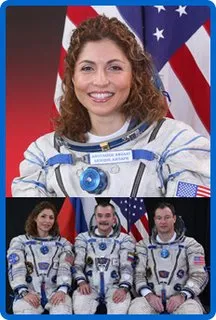
The journey began on September 18. I was launched from the Baikonur Cosmodrome in Kazakhstan with NASA astronaut of Spanish origin Miguel López-Alegría and Russian cosmonaut Mikhail Tyurin. To my surprise, I felt calm and entirely at home, despite the discomfort of the capsule, the thunderous ride and the extra gravitational forces. I had become the fourth person –the first woman– to go out and explore space with her own money, and the first astronaut of Iranian origin.
After orbiting Earth for two days, we docked with the ISS. I spent the next eight days on board as an active crew member, participating in experiments and enjoying the lightness of space. The hardest part was learning to move without bumping into walls, eat without starting to float and maintain good hygiene conditions in zero gravity.
Gandhi said: "If you want to change the world, you must change the way you want to see the world". Long before my space adventure, I served as a board member of non-profit organizations dedicated to children's welfare. I also worked to enable social entrepreneurs to produce radical changes globally.
Now that I was able to fulfill a lifelong dream, my wish is to use the excitement generated by my space trip to inspire all people in the world –especially women and children– to show them that they, too, can achieve the realization of their dreams. I never gave up and worked to make it happen. They can too.
I also want to encourage the commercial exploration of space. By 2030, space tourism may not only be possible and accessible, but it will also be essential for humanity's survival. Space holds resources and room for our expanding population. We have to go and live among the stars to survive and thrive. I hope to go back there someday.
-------

Ansari Blog
Note in El País