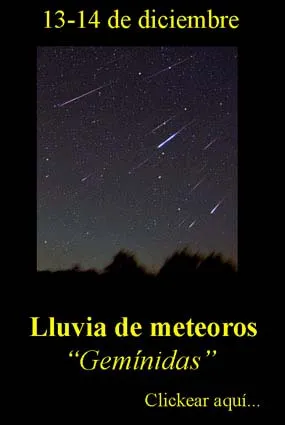
On the night from Wednesday to Thursday
It's almost time for the best shooting star show of 2006: during the night from Wednesday to Thursday, the famous “Geminid” meteor shower will reach its peak activity. Far from the cities, in places with dark skies, dozens and dozens of shooting stars can be observed throughout the early morning. All with the naked eye. In Buenos Aires and other large urban centers, light pollution will dim part of the phenomenon, but it will still be worth looking at the sky.
Via Planetario Galileo Galilei
Shooting stars
We have all seen “shooting stars,” those very fast streaks of light that sometimes cross the night sky from side to side. The curious thing is that, despite their name, they have nothing to do with stars: they are just rocky particles that enter the atmosphere, burn up (at about 80 kilometers high) and shine. On a typical night, a few can be seen. However, from time to time, when Earth passes through the “rivers” of dust left by some comets, the number of particles falling on the planet is much greater. And then, we have a “meteor shower.”
Here come the “Geminids”
There are about 40 meteor showers per year, but the vast majority are very weak. And in general, the “Geminid” meteor shower is usually the richest and most reliable of all (only surpassed by rare episodes of the “Leonids”). It is called that because it seems to spring from the region of the sky occupied by the constellation Gemini. And it originates from particles from the strange Phaethon, a dead comet. The “Geminids” are bright, white shooting stars, although some are yellow, red or green.
This year the conditions are very good, given that the Moon's light will hardly be a nuisance: our satellite will only appear above the horizon around 1:40 (on Thursday), and only 35% illuminated, in a clear waning phase.
When, how and where to observe the Geminids?
When: although it is true that the phenomenon extends from December 7 to 17, its peak activity will occur during the night of Wednesday the 13th to Thursday the 14th, between 23 h and 4:45 in the morning, when the brightness of twilight will already be very noticeable. In any case, it may be interesting to observe on the nights from Tuesday to Wednesday and from Thursday to Friday, at the same times.
How: these phenomena are ideal for viewing with the naked eye. Telescopes or binoculars are not needed, instruments that would only narrow the field of view. You need to be in a dark place, under the open sky and without nearby lights.
Where to look: you must look towards the North and towards the highest part of the sky (the zenith). That's why it's best to lie down on the floor, or on a deck chair.
How many shooting stars?
Although it is true that this powerful and reliable meteor shower favors the Northern Hemisphere (where the constellation Gemini appears very high in the sky), from Argentina we will be able to enjoy a good show. But that will depend crucially on our observing location: in cities, many fewer shooting stars will be seen than in the countryside or in other areas far from urban centers. It's simple: the darker the sky, the greater the number of observable meteors.
Numbers? Taking into account the experience of different observers from the Planetario de la Ciudad de Buenos Aires in previous episodes (from 1997 to date), it is very likely that in the early morning of Thursday the 14th (especially between 1:00 and 4:00 h), far from the cities, we can see between 30 and 40 Geminid meteors per hour. In large urban centers the number could range between 5 and 15 per hour.
In any case, it will be worth staying up late: if the clouds don't interfere, on the night from Wednesday to Thursday the Geminid meteors will surprise us again, justifying their well-deserved astronomical fame.
More info at: Ciencia@Nasa