Astronomers may have seen the first stars of the Universe. If so, these stars are incredible, some 1,000 times more massive than our Sun.
The alternative is equally interesting. These objects could be primitive black holes consuming gas voraciously.
Via Space.com
The observations, with NASA's Spitzer Space Telescope, were reported in a preliminary analysis in November 2005 in the journal Nature. A new analysis was announced today, according to Space.com
"We are pushing our telescopes to the limit and are tantalizingly close to getting a clear picture of the very first collection of objects in the Universe," said Alexander Kashlinsky of the Goddard Space Flight Center and lead author of two reports to be published by Astrophysical Journal Letters. "Whatever these objects are, they are incredibly bright and very different from anything that exists today."
The light comes from objects that are more than 13,000 million light-years away. The Universe is thought to be only a little older, around 13.7 billion years, and astronomers are fairly sure it took a few hundred million years for matter from the Big Bang to allow the formation of the first stars.
However, these newly found objects appear to be the infants of the Universe. But what are they? If they are stars, they have about 10 times more mass than what theories suggested the first stars should have.
These mysterious objects are in clusters that could be the first mini-galaxies. If so, each one has a mass less than a million suns. Our Milky Way, in contrast, has the mass of about 100,000 million suns and is thought to have been created from the merger of smaller galaxies—perhaps like the ones astronomers may have seen.
When light travels to us from near the beginning of the Universe, it is stretched. Other observations of the first lights of the Universe were made in the microwave range. This cosmic microwave background reveals patterns of matter, but not specific objects.
The light measured in the new study is thought to have started as ultraviolet and stretched over time into the infrared range. Kashlinsky's team calls it the Cosmic Infrared Background.
Difficult observations
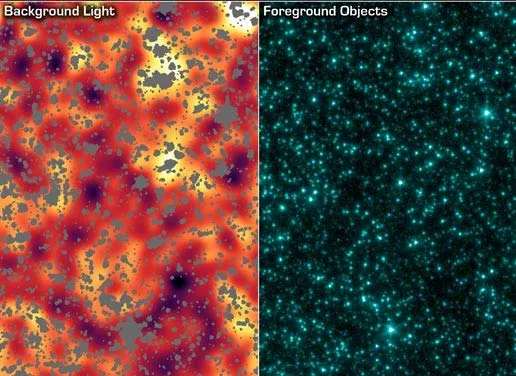
The problem lies in that the observations are not clear enough. Scientists must remove background light from stars and galaxies. "Imagine trying to see fireworks on a night in a big city. If you could turn off the city lights, you could clearly see the fireworks," suggested Kashlinsky. "We have to turn off the lights of the Universe to see its first fireworks."
Researchers hope that the planned James Webb Space Telescope will be able to identify the nature of these recently found clusters.
-------
About the image:
The panel on the right is a NASA Spitzer Space Telescope image of stars and galaxies in the Ursa Major constellation. The panel on the left is the same image after masking stars, galaxies, and other sources. Image credit: NASA/JPL-Caltech/GSFC
-----------------
Translation: Gerardo Blanco