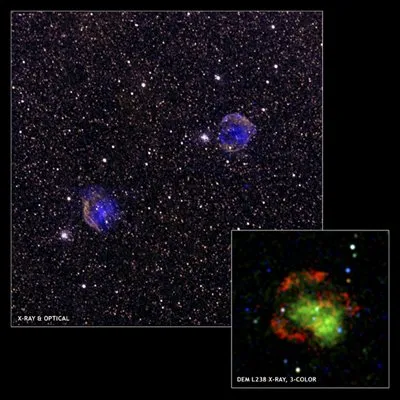
DEM L238 and DEM L249 are two supernova remnants in the Large Magellanic Cloud. X-ray data from NASA's Chandra Observatory and ESA's XMM-Newton suggest that the stars responsible for these remnants were unusually young when they were destroyed by thermonuclear explosions.
Via Chandra Observatory.
The image is a composite of DEM L238 (right) and DEM L249, from the Chandra X-ray Observatory, in blue and white.
This reveals how DEM L238 appears in the three X-ray emission bands (low-energy X-rays are shown in red, medium-energy in green, and high-energy in blue). The central region is green, indicating it is rich in iron. This overabundance of iron identifies the object as a type Ia supernova.
In a type Ia supernova, a white dwarf -the final dense state in the evolution of a star like our Sun- takes so much mass from a companion star until it can no longer support its own weight. The star collapses and the temperature becomes high enough for carbon fusion to occur. Almost simultaneously, the star explodes.
Something surprising in these images is that the iron in the central regions of DEM L238 and L249 is much denser than in most type Ia supernovae. The most likely explanation for these results is that the white dwarf exploded in a very dense environment. This implies that the stars that evolved into white dwarfs were more massive than usual, as those stars expelled more gas into their surroundings. These stars would have exploded in much less time -about 100 million years- than astronomers think type Ia typically require, some billions of years.
"We know that the more massive a star is, the shorter its lifetime will be," said Kazimierz Borkowski of North Carolina State University. "If such a star could also start taking matter from its companion at an early age, then this star will reach its explosion moment faster, in only about 100 million years -much less than other type Ia supernovae."
Other teams have independently found evidence of these early type Ia explosions, through optical observations, but at much greater distances where the stellar explosion environment cannot be probed. The X-ray data from L238 and L249 represent nearby examples of this type of explosion.
If type Ia supernovae could occur so quickly, they could have existed much earlier in the history of the Universe than believed, allowing the testing of expansion at that time. Another possibility is that early type Ia supernovae might also differ in other properties. If so, the presumption that type Ia are standard candles could be compromised, complicating attempts to study dark energy.
After finding evidence of early type Ia explosions in the Large Magellanic Cloud, a nearby galaxy, researchers are looking for other remnants in our galaxy to see if they can be examples of this potential new class of supernova. For example, the famous supernova observed by Johannes Kepler in 1604 could have been of this type.
Chandra press note:
X-ray Evidence Supports Possible New Class Of Supernova