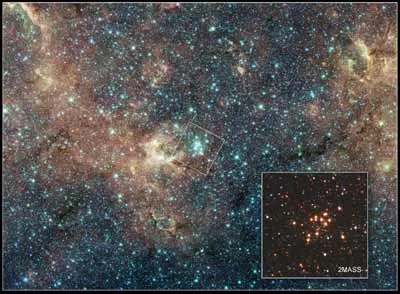
Wrapped in a cloud of charged bubbles, a cluster of young, massive stars has revealed a new source of gamma-ray energy in our galaxy, as reported at the first GLAST symposium in Palo Alto, California.
Via Space.com
Gamma rays have the smallest wavelengths and have more energy than any other light wave in the electromagnetic spectrum.
Until now, supernova remnants were the dominant source of these energy rays.
Called Westerlund 2, the cluster contains young and extremely massive stars called Wolf-Rayet, one of which -WR 20a- holds the distinction of being the most massive known binary in our Milky Way. Each of these stars weighs about 80 solar masses.
Wolf-Rayet stars, named after their discoverers, begin their life as cosmic Goliaths, about 20 times the mass of our Sun. Near the end of their stellar lives, the giants rapidly lose matter from their surface through a supersonic stellar wind. The intense heat and radiation from their cores can drive stellar winds at speeds from 3.6 to 9 million kilometers per hour!
The international team of astrophysicists located the stellar bubbles with HESS (High Energy Stereoscopic System) in Namibia.
Astronomers say the gamma radiation appears to extend beyond the cluster and shows a constant emission rate.
In the Westerlund 2 cluster, the stellar wind has created bubbles around the stars. The energy of this stellar wind was found to be close to the equivalent obtained in supernova explosions.
"The stars provide really massive particles that are carried outward by the stellar wind, which then gain more energy from the turbulent motions in the bubble that transfers energy to the cosmic rays providing a plausible mechanism for particle acceleration," said Luke Drury of the Dublin Institute for Advanced Studies.