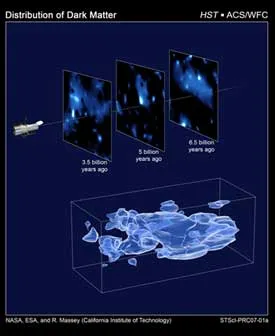
An international team using NASA's Hubble Space Telescope has created the first three-dimensional map of the distribution of dark matter in the universe.
Via NASA
Dark matter is an invisible form of matter whose total mass in the Universe is more than five times that of normal matter, like atoms. The nature of dark matter is still unknown. Its presence is inferred by its influence on galaxies and clusters and the gravitational effect on the evolution of universal structure. The first detection of dark matter was made last year through observations of galactic clusters.
This new map provides the best evidence to date that normal matter, largely in the form of galaxies, accumulates through dense concentrations of dark matter. The map reveals a network of filaments that grow over time and intersect in massive structures at the locations of galaxy clusters.
The dark matter map was constructed by measurements of the shapes of half a million distant galaxies. To reach Hubble, the light from the galaxies traveled through the intervening dark matter, which distorts this light. The researchers used these observations to construct the distribution of intervening mass along the line of sight of the space telescope, a method called "weak gravitational lensing".
For astronomers, the challenge of mapping the Universe's dark matter has been similar to doing it for a city through nighttime aerial photos, showing only the streetlights. Dark matter is invisible, so only luminous galaxies can be seen directly.
Carrying out this mapping of the distribution of dark matter is fundamental to understanding how galaxies and clusters grow over billions of years. Tracing the evolution of this matter can eventually shed light on the so-called dark energy, a repulsive form of gravity that could have influenced the way dark matter accumulates.
The research results appeared online today in the journal Nature and were presented at the 209th meeting of the American Astronomical Society in Seattle, by Richard Massey and Nick Scoville, both from the California Institute of Technology in Pasadena.
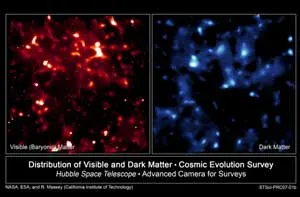
Image credit: NASA, ESA, CalTech.
The researchers created the map using the largest survey to date of the Universe, the Cosmic Evolution Survey, also known as COSMOS. It covers an area of the sky nine times larger than the full Moon. To add three-dimensional distance data, the Hubble observations were combined with information from ground-based telescopes like the European Very Large Array in Chile, the Japanese Subaru in Hawaii, the American VLA radio telescope in New Mexico as well as the ESA's orbital telescope, the XMM Newton, for X-rays.