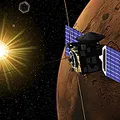
The European probe Rosetta passed within only 250 km of Mars on Saturday night into Sunday, allowing it to take a series of photographs of the 'red planet', the European Space Agency (ESA) announced this Sunday. Launched three years ago, Rosetta will end its mission in May 2014.
Via La Flecha
By then, it will have traveled 7,100 million kilometers. "Between 3:13 h and 3:40 h, the Rosetta probe passed within only 250 km of Mars," the ESA specified in a statement. The agency explained that when the probe approached the planet, the technical instruments it carries were activated to obtain images of it.
"The Mars flyby was the most delicate stage since the mission's launch," declared Manfred Warhaut, head of the Mission Control department. "The probe has returned to fly by Earth, where it will arrive in November.
In the next gravity-assist maneuver, Rosetta will regain a new impulse that will allow it to reach the asteroids and the comet" Tchuriumov-Guerassimenko, its final objective, added Warhaut. Launched on March 2, 2004 by an Ariane rocket, Rosetta is the first probe designed to go into orbit around comets in the solar system.
The European probe is also the first with the capability to land on these celestial bodies with very eccentric orbits and generally formed by a low-density nucleus and a luminous atmosphere that precedes, envelops, or follows them, depending on their position relative to the Sun. Scientists hope that Rosetta will provide them with precious information about the primitive space nebula that gave rise to our solar system, about 4,500 million years ago.
This Mars flyby maneuver, which began to be prepared in August of last year, was necessary so that the European probe Rosetta could use the gravitational field of the Red Planet as a brake, and to modify the orbit and direction on its ten-year journey to comet Churiumov-Guerasimenko.
The director of ESA's science programs, David Southwood, considered that "to understand the beginning of life on Earth it is necessary to go back to the origin of the Solar System, which begins with the type of materials found in comets."
Rosetta is now heading towards Earth and will approach it again in November of this year to then take advantage of the impulse from its gravity field and continue its 7,100 million kilometer journey to Churiumov-Guerasimenko.
This technique, called "swing-by," is used to transfer energy from a planet to a probe so that the spacecraft's speed and trajectory can be modified to direct it to its target.
Gravity assistance produces conditions equivalent to those that would have been achieved by launching the probe with a much more powerful rocket.
In Rosetta's case, this technique was necessary because the launcher would not have been able to take it directly to comet Churiumov-Guerasimenko.
Rosetta's initial trajectory did not foresee the eclipse, but the delays that occurred in the launch date forced the spacecraft's trajectory to be modified in order to direct it to the comet.
The mission's scientists also took advantage of the Mars flyby to perform observations and calibrations with some of the 21 instruments the spacecraft carries on board.
Once the eclipse ended, as soon as the solar panels received sunlight and solar energy, the observation of Mars and its moon, Phobos, began.
In early March 2005, Rosetta approached Earth for the first time over Mexico, where it passed at a minimum distance of 1,900 kilometers, at a speed of about 38,000 kilometers per hour, that is, about 40 times faster than a passenger plane.
On March 2, 2004, ESA launched the Rosetta probe into space from the European base in Kourou (French Guiana) to follow, for the first time in history, comet 67P/Churiumov-Guerasimenko in its orbit and meet it in November 2014.
This project, which cost 1,000 million euros (1,310 million dollars), will provide new data about the interior and origin of the Solar System and the keys to understanding the emergence of life on Earth.