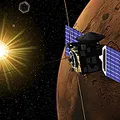
Mars Express and Venus Express to extend their operations
Via EurekAlert
The ESA missions to explore Mars and Venus will continue operating until May 2009. The decision was taken on Friday by unanimous vote of the European agency's Science Programme Committee.
The results achieved by Mars Express include evidence of volcanic, fluvial and glacial activity from a very early age of the Red Planet, the discovery of subsurface water thanks to the first subsurface radar sounding on another planet, the first detailed study of the surface mineralogical composition, which also provided evidence of a watery past on Mars, the detection of methane in the atmosphere, measurements of ozone, the existence of mid-latitude auroras or the detailed and quantitative indications of the atmospheric escape process, among other valuable achievements.
The greatest challenge is the global completion of coverage in general terms, continuing to obtain this type of data and the high-resolution images for their geological interpretation, selecting candidate sites for the landing of future missions, etc.
Venus Express is still halfway through its mission as initially planned, but has already obtained details of the planet, such as its vortex at the Venusian south pole and data on its complex atmospheric structure, cloud system and winds. It has also obtained preliminary measurements of atmospheric temperature and chemistry and the analysis of the atmospheric escape process in combination with the action of the solar wind, fundamental for understanding the history of water and the evolution of the planetary atmosphere.
Planetary climate experts expect even more from the mission to better understand atmospheric effects here on our planet as well. The extension will allow achieving global coverage of the atmosphere as well as a better analysis of surface temperature and chemical maps to try to find out if Venus is a geologically and volcanically active planet still.